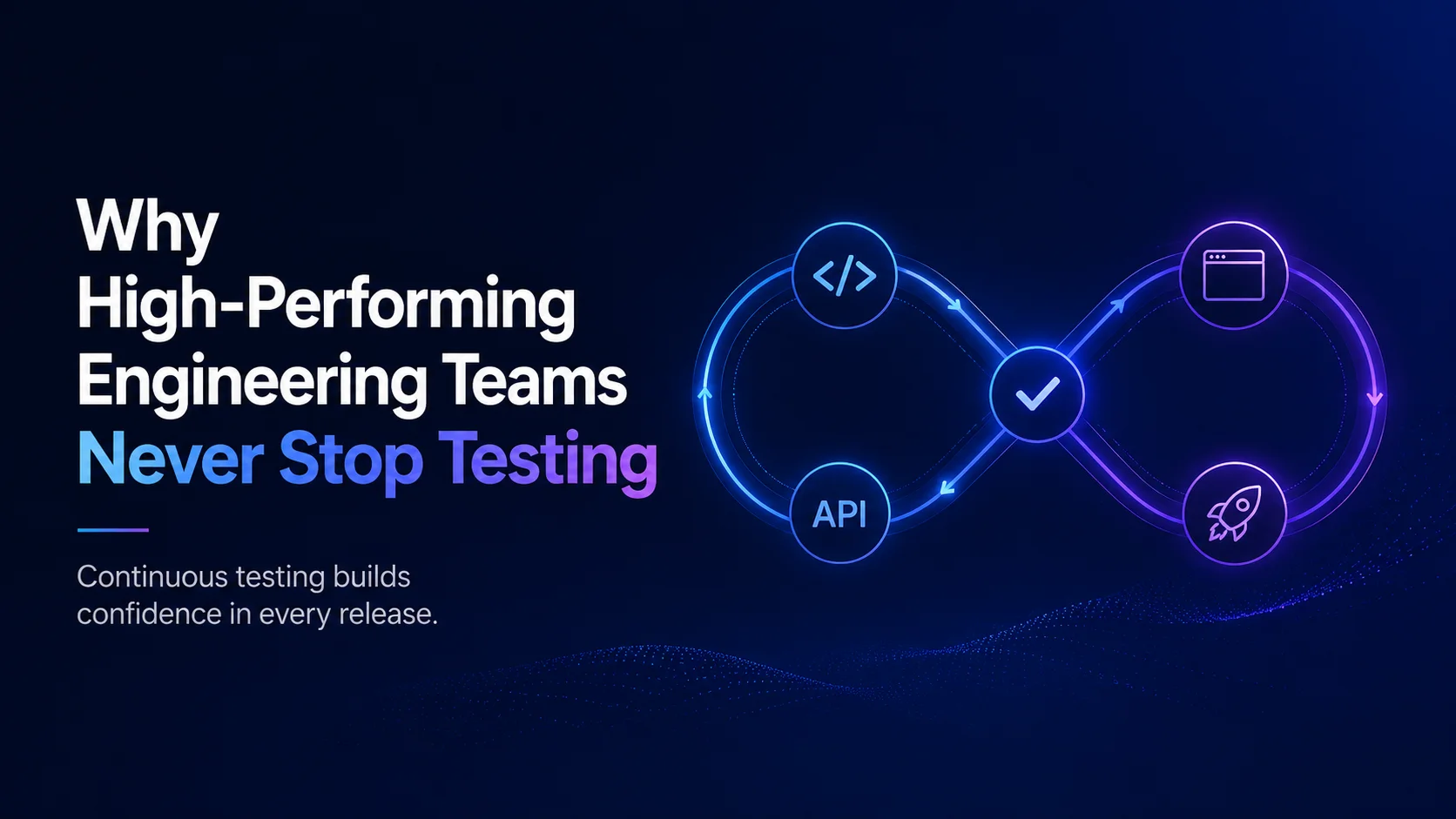
Why High-Performing Engineering Teams Never Stop Testing
Software Is Moving Faster Than Ever. Is Your Quality Strategy Keeping Up?
Every engineering organization is under pressure to deliver software faster.
Customers expect new features weekly. Product teams want shorter release cycles. Developers are shipping code at unprecedented speeds, often with the assistance of AI-powered coding tools.
Yet one question remains unchanged:
How do you release software faster without increasing production risk?
For many organizations, the answer is still "test more."
Unfortunately, testing more isn't the solution.
Running a 6-hour regression suite before every deployment doesn't make your software safer it creates bottlenecks that slow innovation. Likewise, relying on manual release approvals or waiting until the end of a sprint to validate software simply shifts problems downstream, where defects are significantly more expensive to fix.
The organizations leading today's digital transformation have adopted a different philosophy.
They've stopped treating testing as a release activity and started treating it as a continuous engineering capability.
That philosophy is known as Continuous Testing.
Continuous Testing Is About Confidence and Not Just Automation
One of the biggest misconceptions in software development is that Continuous Testing simply means running automated tests inside a CI/CD pipeline.
It doesn't.
Continuous Testing is the practice of validating software continuously throughout the Software Development Life Cycle (SDLC), ensuring that every code change is evaluated before it reaches production.
Rather than asking:
"Did the tests pass?"
Engineering leaders begin asking:
- Is this release safer than the last one?
- Which business capabilities are affected?
- Are our APIs still compatible?
- Has customer risk increased?
- Do we have enough confidence to deploy?
Continuous Testing transforms software quality from a reactive process into a proactive engineering discipline.
The Continuous Testing Journey
Modern software should be validated progressively and not all at once.
Instead of waiting until the end of development, every stage of the delivery pipeline contributes to release confidence.
Stage 1 – Build Quality into Every Commit
The moment a developer commits code, automated validation begins.
Within minutes, the pipeline should verify:
- Code compiles successfully
- Unit tests pass
- Static Application Security Testing (SAST) identifies vulnerabilities
- Coding standards are enforced
- Dependency scans detect known security risks
Developers receive immediate feedback while the code is still fresh in their minds, dramatically reducing the cost of fixing defects.
Stage 2 – Validate APIs Before User Interfaces
Modern applications are powered by APIs.
If an API fails, the user interface will eventually fail as well.
That's why mature engineering organizations validate APIs before launching expensive browser automation.
API Testing confirms:
- REST endpoints
- GraphQL services
- Authentication
- Authorization
- Data validation
- Database integrity
- Integration contracts
Finding issues at the API layer is significantly faster than discovering them through UI testing.
Stage 3 – Protect the Customer Experience
Once backend services have been validated, attention shifts to the customer.
Automated UI Testing verifies:
- Critical business workflows
- Cross-browser compatibility
- Responsive web design
- Mobile application functionality
- Accessibility compliance
- User experience consistency
Frameworks such as Playwright and Cypress enable parallel execution across multiple browsers and devices, allowing organizations to validate customer journeys in minutes rather than hours.
Stage 4 – Validate Performance and Security
Quality extends far beyond functionality.
Every release should also validate:
- Performance
- Scalability
- Security
- Accessibility
- Compliance
Load testing ensures applications can handle expected traffic.
Security testing identifies vulnerabilities before attackers do.
Accessibility testing verifies compliance with WCAG and ADA standards, ensuring digital experiences are usable by everyone.
The Biggest Challenge Isn't Automation. It's Trust
Many organizations proudly report that they've automated thousands of test cases.
Yet developers still hesitate before every deployment.
Why?
Because they've lost confidence in the automation itself.
Flaky tests.
Shared environments.
Unstable test data.
Long execution times.
False positives.
These problems create friction throughout the development lifecycle.
Continuous Testing isn't simply about writing more automation.
It's about building automation that engineers trust.
When developers trust the pipeline, software moves through it naturally.
Deployments become routine instead of stressful.
Continuous Testing Doesn't End at Deployment
Historically, testing stopped once software reached production.
Today's engineering organizations know that's where learning begins.
Production telemetry provides invaluable insights into software quality.
Continuous Quality Monitoring allows engineering teams to measure:
- API reliability
- Application performance
- Error rates
- Customer impact
- Defect trends
- Release stability
Instead of reacting to production incidents, organizations begin identifying patterns before customers are affected.
Testing evolves into Quality Intelligence.
From Continuous Testing to Quality Intelligence
The future of software quality isn't executing more tests.
It's understanding what those tests actually mean.
Imagine every deployment producing answers like:
- Which business workflows remain untested?
- Which APIs are becoming unstable?
- Which teams generate the highest defect rates?
- Which applications carry the greatest release risk?
- Where should engineering invest next?
This is where Continuous Testing becomes Quality Intelligence.
Testing data transforms into engineering insight.
Engineering insight transforms into better business decisions.
The Next Evolution: AI-Powered Continuous Testing
Artificial Intelligence is already changing how software is developed.
Developers are using AI to generate:
- Source code
- Unit tests
- Documentation
- API mocks
- Test data
- Automation scripts
The next generation of Continuous Testing platforms will leverage AI to:
- Generate regression scenarios automatically
- Identify impacted test cases
- Detect coverage gaps
- Predict release risk
- Prioritize testing based on business impact
- Self-heal broken automation
- Recommend additional validation before deployment
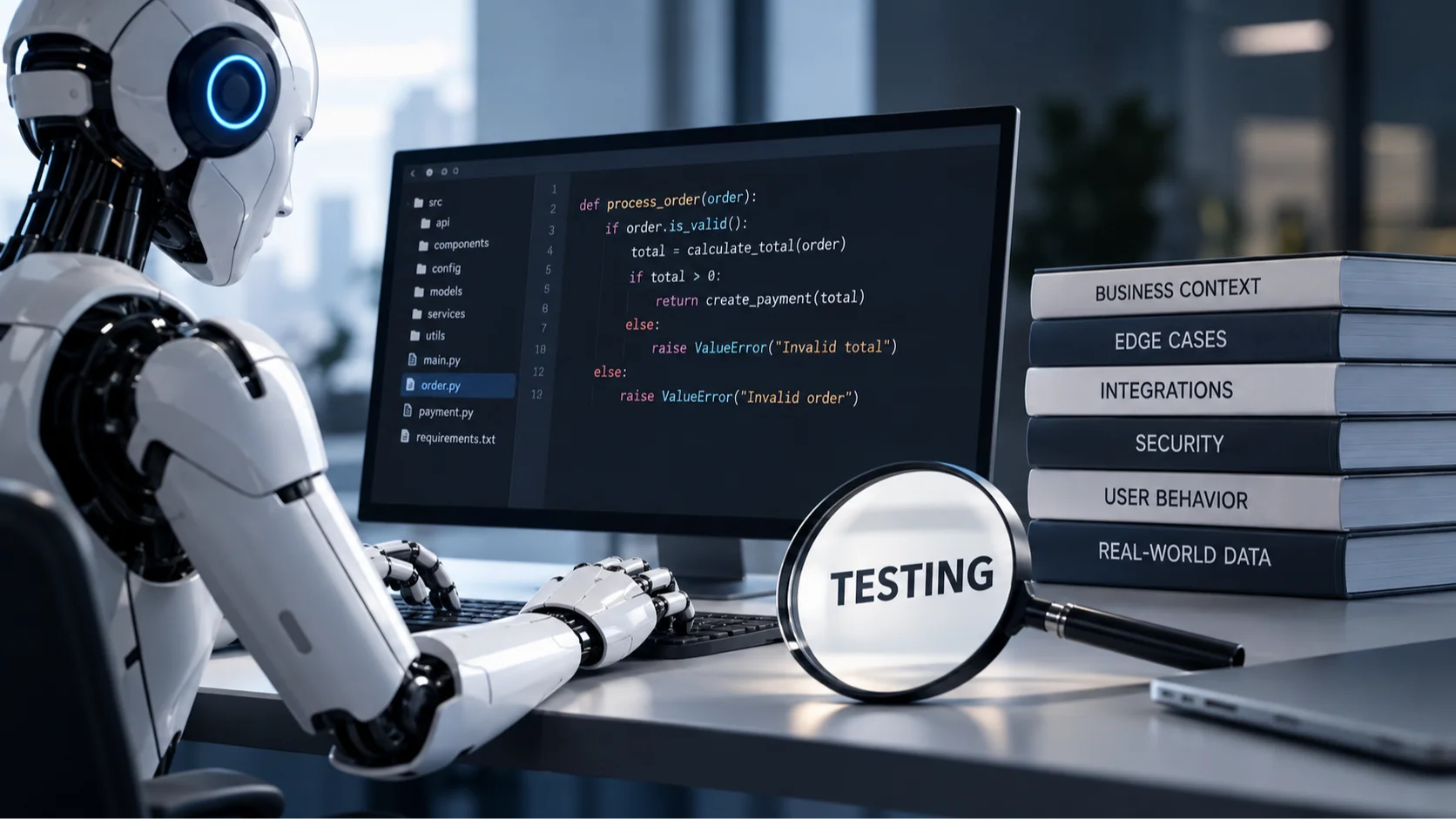
Rather than replacing Quality Engineers, AI will allow them to focus on strategy, architecture, risk analysis, and engineering excellence.
The future isn't autonomous testing.
The future is autonomous confidence.
Continuous Testing Is a Competitive Advantage
Organizations that continue treating testing as the final step before deployment will always struggle to balance speed with quality.
Those that embrace Continuous Testing build quality into every commit, every pipeline, and every release.
The result is more than faster software delivery.
It's better engineering.
Better customer experiences.
Lower operational risk.
And greater confidence in every deployment.
Because the ultimate goal of Continuous Testing isn't simply to ship software faster.
It's to ensure every release is one your business can trust.
Key Takeaways
✔ Continuous Testing is a Quality Engineering strategy not just an automation strategy.
✔ Every stage of the CI/CD pipeline should contribute to software quality.
✔ API Testing, UI Testing, Mobile App Testing, Accessibility Testing, and Security Testing work together to build Release Readiness.
✔ Quality Intelligence transforms testing data into executive decision support.
✔ AI will accelerate Continuous Testing, but engineering judgment will remain essential.
Final Thought
The fastest engineering teams aren't the ones writing the most code. They're the ones building the most confidence into every release.
That is the future of Quality Engineering. That is the promise of Continuous Testing. And that is how organizations will deliver software at the speed modern business demands without compromising quality.