Automation is supposed to save time.
But what happens when maintaining the automation takes almost as much effort as the testing it replaced?
For many organizations, legacy automation frameworks continue running because they already exist. The scripts have been written. The infrastructure has been configured. Teams know how the system works.
From a budget perspective, keeping the existing framework can appear cheaper than replacing it.
But that calculation often ignores the real cost.
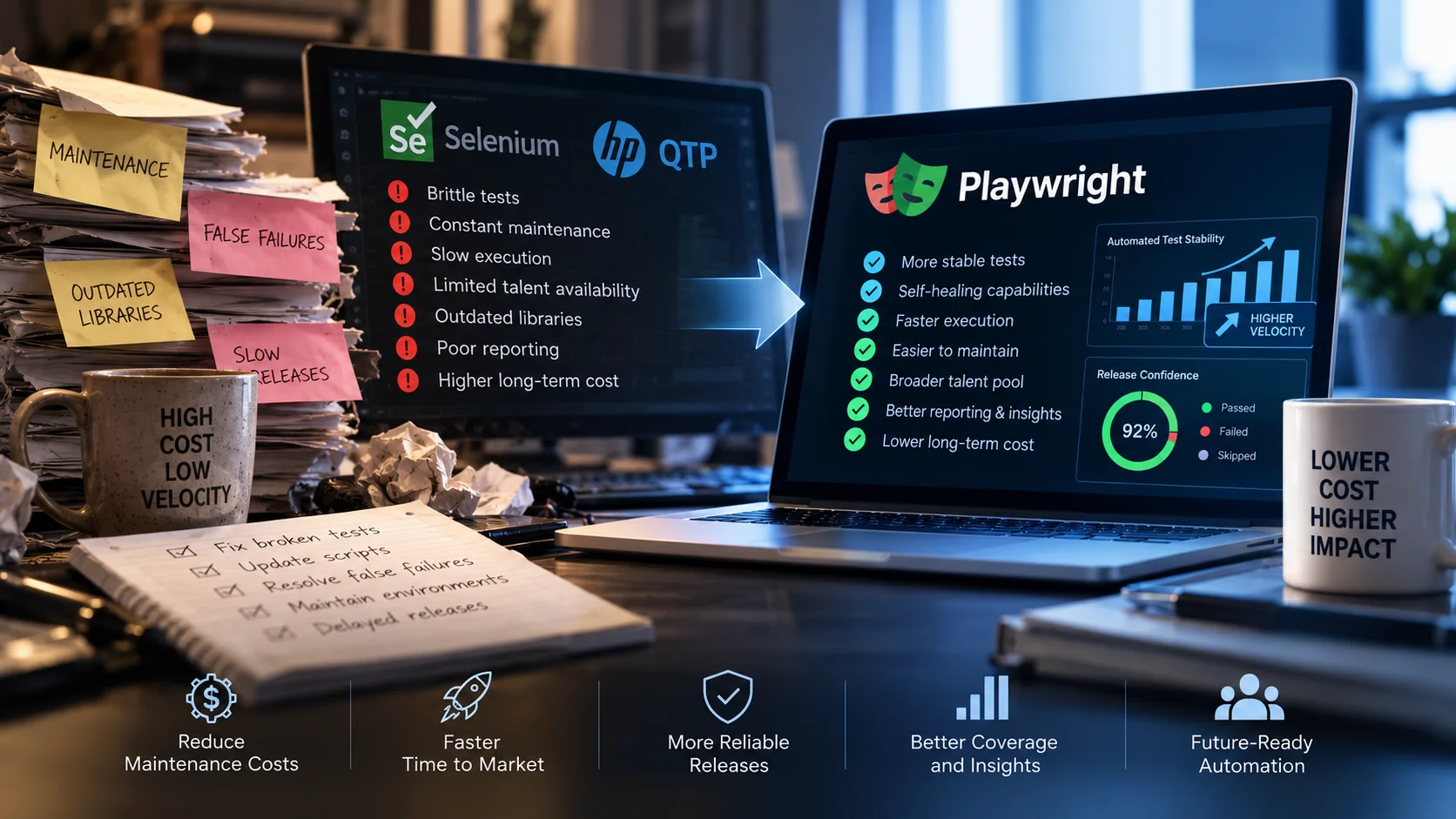
An aging Selenium suite, a legacy QTP implementation, or a heavily customized automation framework can quietly consume engineering hours, delay releases, generate false failures, complicate onboarding, and limit test coverage.
The license or infrastructure cost may be visible.
The operational drag often is not.
That is why technology leaders should evaluate automation through total cost of ownership, not simply the cost of the testing tool.
The Framework May Be Paid For, but You Are Still Paying for It
One of the strongest arguments for keeping a legacy framework is simple:
"We have already invested in it."
That is true.
But previous investment does not determine whether the framework remains economical today.
Imagine an automation suite that requires several engineers to investigate flaky failures after every major test run. The framework itself may have little incremental licensing cost, but the organization is still paying for:
- Engineering hours spent maintaining scripts
- Time spent investigating false failures
- Longer regression cycles
- Delayed releases
- Outdated dependencies
- Specialized skills needed to maintain older technology
- Infrastructure required to execute inefficient suites
- Coverage gaps caused by tests that are too difficult to automate
- Onboarding time for engineers unfamiliar with the framework
These costs rarely appear together on a single invoice.
They are distributed across engineering budgets, sprint capacity, release timelines, infrastructure spend, and production risk.
That makes them easy to underestimate.
What Total Cost of Ownership Really Means for Test Automation
When organizations compare automation frameworks, they often focus on initial implementation cost.
A better comparison considers the entire lifecycle.
The total cost of ownership, or TCO, of an automation framework should include several categories.
1. Test Maintenance
How frequently do scripts break because the application changes?
How much time does the QA team spend updating selectors, repairing workflows, maintaining utilities, or fixing outdated dependencies?
If engineers repeatedly repair the same automation instead of expanding coverage, maintenance has become a significant operational cost.
2. Test Execution Time
Slow regression suites affect more than QA.
If developers wait hours for feedback, defects are discovered later and release pipelines become longer.
As the test suite grows, inefficient execution can create a bottleneck across the entire software delivery lifecycle.
3. False Failures and Flaky Tests
A failed automated test should communicate something valuable.
When teams stop trusting failures because the framework produces too much noise, automation loses much of its value.
Every false failure requires someone to investigate.
Was there a real defect?
Did the test break?
Was the environment unstable?
Was the locator outdated?
Multiply that investigation across hundreds or thousands of test runs and the cost becomes significant.
4. Talent and Onboarding
Legacy frameworks can also create a people problem.
New engineers may be experienced with modern testing tools but unfamiliar with an organization's older or highly customized framework.
The company then spends additional time training new hires on technology that may already be approaching the end of its useful life.
Organizations can also become dependent on a small number of people who understand the framework deeply.
That creates knowledge concentration and continuity risk.
5. Infrastructure
Older automation architectures may require additional machines, longer-running environments, or complicated execution configurations.
A framework that takes hours to complete regression testing may consume substantially more infrastructure than one designed for modern parallel execution.
The difference becomes increasingly important as test volume grows.
6. Delayed Releases
This is one of the largest hidden costs.
If regression testing adds hours or days to a release cycle, the financial impact extends beyond the QA department.
Delayed releases can mean:
- Features reach customers later
- Revenue opportunities are postponed
- Developers wait longer for validation
- Hotfixes become more disruptive
- Competitors move faster
The real cost of automation should therefore include its effect on time to market.
Why Legacy Selenium Suites Can Become Difficult to Maintain
Selenium remains widely used and can still be appropriate for many testing environments.
The problem is not that Selenium is automatically "legacy."
The problem arises when organizations accumulate years of custom scripts, utilities, dependencies, workarounds, and architectural decisions around an aging implementation.
A mature Selenium suite may contain thousands of tests built by different engineers across different periods.
Over time, the organization can inherit:
- Inconsistent coding patterns
- Fragile selectors
- Duplicate test logic
- Outdated libraries
- Complex setup requirements
- Slow execution
- Limited observability
- Flaky tests
At that point, the challenge is no longer simply Selenium.
It is the accumulated maintenance burden surrounding the framework.
The same principle applies to QTP and other older automation environments.
The Cost of a Flaky Test Is Bigger Than It Looks
Flaky automation deserves special attention because its cost compounds.
Suppose a regression suite reports 40 failures.
If the team knows that many of those failures may be false positives, engineers cannot immediately treat the report as evidence of application problems.
Someone must investigate.
Tests are rerun.
Logs are reviewed.
Environments are checked.
Failures are compared.
Developers may be contacted.
Eventually, the team determines that only a handful represent actual defects.
The direct cost is the investigation time.
The larger cost is loss of trust.
Once teams stop trusting automation results, they begin adding manual verification.
Now the organization is paying for automation while still performing manual work to confirm whether the automation can be trusted.
That is a warning sign that the framework's TCO may be significantly higher than it appears.
Modern Frameworks Change the Economics of Automation
Modern automation frameworks such as Playwright have changed what teams can expect from test infrastructure.
Features such as modern browser automation, parallel execution, stronger debugging capabilities, tracing, automatic waiting, and improved developer experience can reduce some of the friction associated with older automation architectures.
Modernization can potentially help teams achieve:
- Faster test execution
- More reliable automated tests
- Easier debugging
- Reduced maintenance
- Better CI/CD integration
- Faster onboarding
- Improved reporting and observability
However, migration should not be treated as a simple tool replacement.
Moving from one framework to another without addressing poor test design, weak governance, or unnecessary coverage can simply recreate the same problems using newer technology.
The objective is not:
"Replace Selenium with Playwright."
The better question is:
"How do we design an automation ecosystem that costs less to maintain while providing greater confidence?"
Self-Healing Automation Can Reduce Maintenance, but It Is Not Magic
Modern automation increasingly incorporates self-healing capabilities designed to reduce test failures caused by changes in the application.
For example, when a UI element changes, a more resilient testing system may be able to identify an alternative locator or adapt to certain interface changes.
This can reduce repetitive maintenance.
But self-healing should not become an excuse to ignore application changes.
If a test behaves differently because the product has changed, teams still need visibility into what changed and why.
The purpose of intelligent automation should be to eliminate unnecessary maintenance while preserving meaningful validation.
That distinction matters.
Modernization Is a Business Decision, Not Just a Technical Upgrade
Framework modernization is often presented as an engineering project.
That framing can make it difficult to secure executive support.
Technology leaders are more likely to care about questions such as:
How much engineering capacity are we spending maintaining automation?
How much does regression delay our releases?
How many automation failures require manual investigation?
What important workflows remain untested because the framework is difficult to extend?
How much would modernization improve delivery velocity?
What is the cost of doing nothing for another three years?
Those are business questions.
When automation modernization is evaluated through cost, velocity, risk, and release confidence, the decision becomes much clearer.
How to Calculate the Real Cost of Your Current Framework
Organizations considering modernization should start with a baseline.
Measure the current environment before deciding whether migration is justified.
Look at metrics such as:
Maintenance Hours:
How many engineering hours per month are spent repairing, updating, and troubleshooting automation?
Flaky Test Rate:
What percentage of failures disappear when tests are rerun?
Regression Duration:
How long does the full suite take to provide usable feedback?
Failure Investigation Time:
How much time is spent determining whether failures are defects, test issues, or environment problems?
Coverage Gaps:
Which critical workflows remain manual or insufficiently tested?
Onboarding Time:
How long does it take a new engineer to become productive with the framework?
Release Delay:
How frequently does testing prevent or postpone deployment?
Infrastructure Cost:
What environments and compute resources are required to execute the suite?
Once these numbers are visible, leaders can compare the cost of maintaining the current system against the cost and expected benefits of modernization.
Do Not Migrate Everything Just Because You Can
A full rewrite is not always the best answer.
Large automation suites may contain valuable tests that continue to perform reliably.
Organizations should evaluate the framework strategically rather than automatically replacing every existing script.
Tests can be grouped into categories:
Retain: Stable tests that continue providing value.
Refactor: Important tests that need modernization but do not require complete replacement.
Replace: Brittle or inefficient tests better suited to a modern framework.
Retire: Tests that duplicate coverage or no longer protect meaningful business functionality.
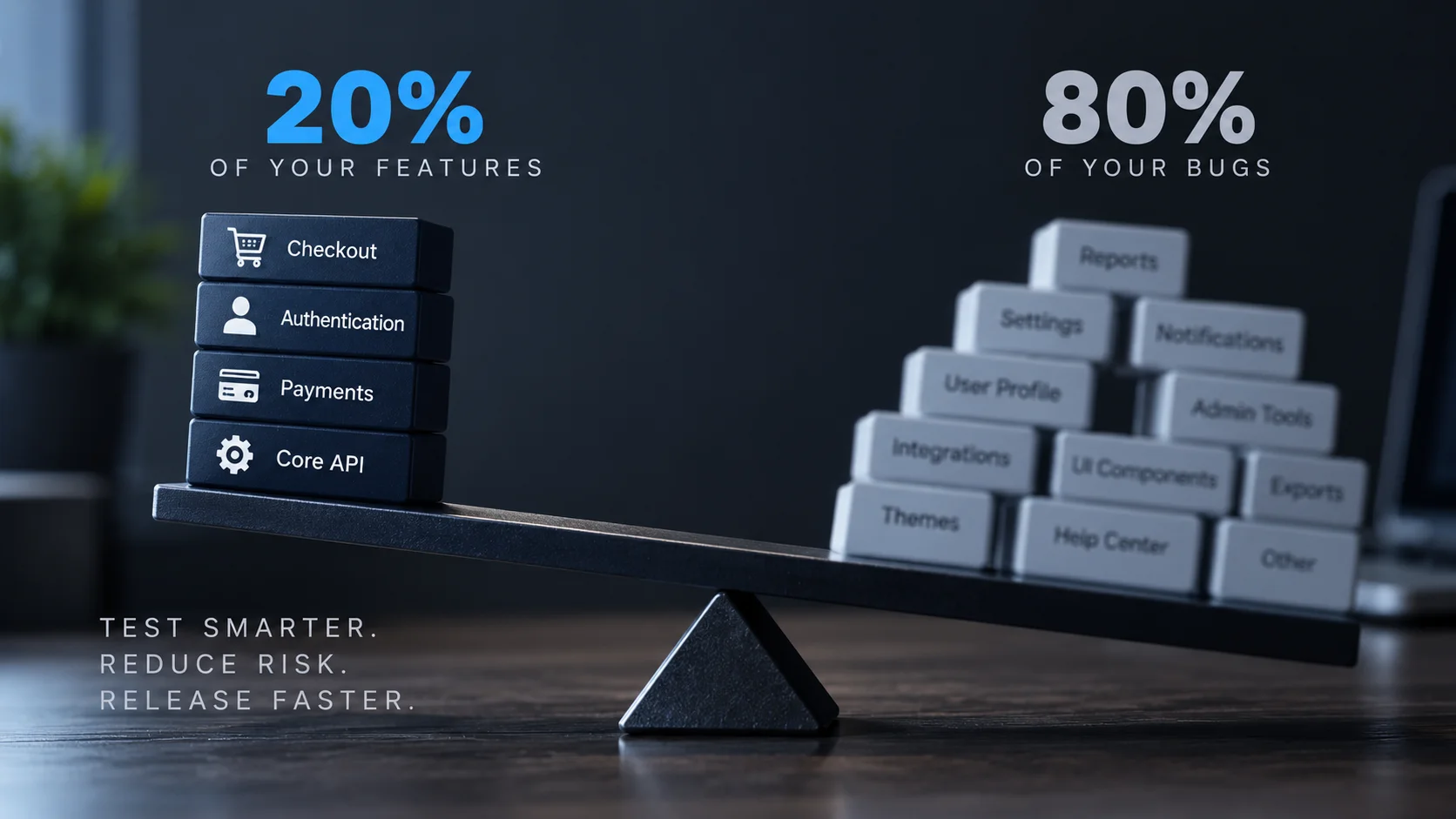
Add: Critical workflows that currently lack adequate automation.
This approach turns migration into a risk-based modernization program rather than a massive rewrite.
Where Quality Intelligence Fits
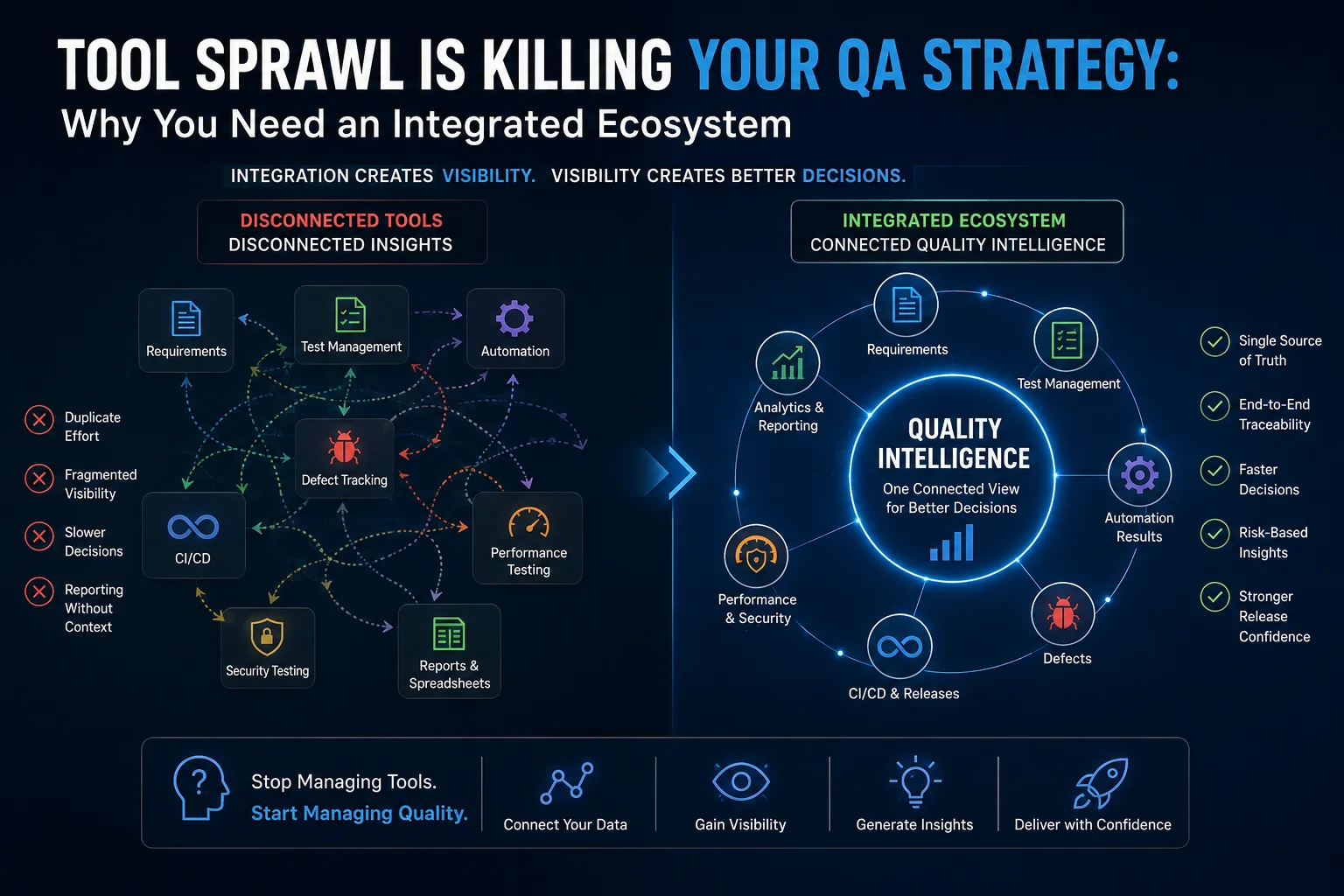
Modern automation solves only part of the problem.
Technology leaders still need to know whether their testing investment is actually improving software quality.
That requires visibility beyond individual test runs.
Quality Intelligence connects automation data with broader signals such as test coverage, defects, requirements, release risk, code changes, and production outcomes.
Instead of asking:
"Did our automation run?"
Leadership can ask:
"Are our highest-risk workflows adequately protected?"
"Where are defects escaping our current coverage?"
"Is automation maintenance improving or getting worse?"
"Which parts of the regression suite provide the most value?"
"Are we ready to release?"
That is the difference between maintaining an automation framework and building a quality ecosystem.
From Automation Maintenance to Quality Engineering
The purpose of automation should never be automation itself.
Automation exists to help teams deliver reliable software faster.
If the framework consumes excessive engineering capacity, produces unreliable results, slows releases, or prevents teams from expanding meaningful coverage, then its business value should be reassessed.
A modern quality strategy connects automation with engineering workflows, governance, risk analysis, and Quality Intelligence.
For QA Bolt, this means moving beyond isolated test execution toward an integrated approach where automation contributes directly to release confidence and business decisions.
The Cost of Doing Nothing
Modernization requires investment.
That makes postponing the decision tempting.
But maintaining the status quo also has a cost.
Every quarter spent repairing brittle scripts is engineering capacity that cannot be spent improving coverage.
Every hour spent investigating false failures is time not spent identifying real risk.
Every delayed regression cycle affects delivery velocity.
Every critical workflow left insufficiently tested increases exposure.
The question is not simply:
"How much will modernization cost?"
Leadership should also ask:
"How much is our current framework already costing us?"
That number may be much larger than expected.
Final Thoughts
Legacy automation can look inexpensive because much of the initial investment happened years ago.
But the true cost of a framework is not what the organization paid to build it.
It is what the organization continues paying to maintain it, trust it, operate it, and work around its limitations.
Modernizing to a framework such as Playwright can be part of the solution, but the bigger opportunity is to rethink how automation contributes to the overall quality ecosystem.
The objective should be lower maintenance, faster feedback, stronger coverage, more reliable releases, and clearer visibility into risk.
That turns automation modernization from technical cleanup into a measurable business investment.
Evaluate your current QA model, identify where legacy automation is creating operational drag and regression coverage gaps, and explore how QA Bolt can help your organization move from test execution to Quality Intelligence.