AI is changing software development at extraordinary speed.
Developers can generate functions, refactor code, create tests, troubleshoot errors, and review pull requests in seconds. Work that once took hours can now happen in minutes.
That speed creates an understandable assumption: if AI can write and review code, software should become more reliable.
The reality is more complicated.
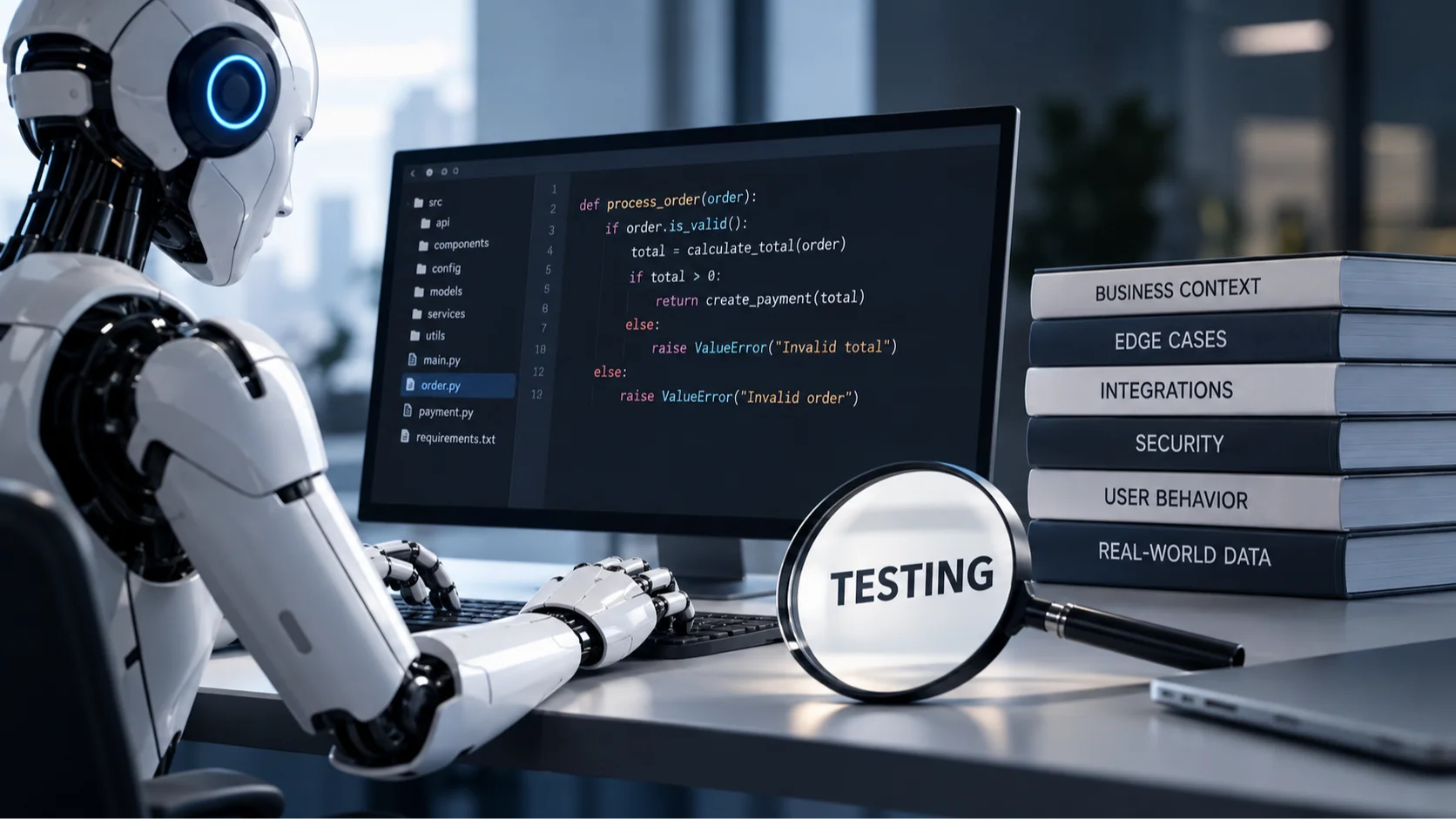
AI can generate code that looks correct, follows familiar patterns, and passes basic checks while still being wrong for the application it is meant to serve.
AI can predict what code should look like. It cannot guarantee that the software will behave correctly in your specific business environment.
As AI-generated code becomes more common, testing does not become less important. Intelligent validation, governance, and Quality Intelligence become even more critical.
AI Can Generate Plausible Code Without Knowing What Correct Means
AI models are remarkably good at recognizing patterns.
Given a prompt, existing code, or technical documentation, an AI system can predict a likely solution based on patterns learned from large amounts of data.
That capability is powerful, but there is an important distinction between plausible code and correct software.
A generated function might compile successfully.
The logic might look reasonable during code review.
Automated checks might even pass.
Yet the implementation can still misunderstand a business rule, mishandle an edge case, introduce an integration issue, or behave incorrectly when exposed to real production data.
Consider a checkout system.
An AI model may generate perfectly valid discount logic based on the instructions it receives. The code could still fail when multiple promotions overlap, currencies change, a payment service times out, or an existing customer qualifies for an exception that was never included in the prompt.
The code itself may not look broken.
The missing piece is context.
The Context Gap Is the Real AI Quality Risk
Software does not operate in isolation.
Every application sits inside a network of requirements, customer expectations, integrations, infrastructure, security controls, historical decisions, and business rules.
AI rarely has complete visibility into all of them.
That creates what engineering leaders should consider a context gap.
An AI model may know how authentication systems are commonly designed. It does not automatically know your organization’s specific access policies.
It may know how APIs typically respond. It does not inherently understand every downstream service depending on your current payload.
It may generate a technically valid database change. It does not automatically know how that change could affect reporting, performance, compliance, or historical data.
The greater the context gap, the greater the possibility that technically reasonable code creates unexpected business risk.
Why AI Code Review Cannot Catch Everything
AI-assisted code review can provide significant value.
It can identify suspicious patterns, highlight possible vulnerabilities, detect inconsistencies, and help developers review changes faster.
However, code review is only one layer of quality assurance.
A reviewer, whether human or AI, cannot always determine whether code fulfills the actual intent of the product simply by examining the implementation.
Imagine an AI reviewer analyzes a newly generated payment function.
The syntax is correct. Error handling exists. The implementation follows accepted coding patterns. No obvious security issue appears.
Production traffic arrives, and the function incorrectly handles one combination of customer type, payment method, and regional tax rule.
The problem was not necessarily bad code.
The problem was incorrect behavior under a condition the review never validated.
That is why code review cannot replace testing.
AI-Generated Code Can Create New Types of Quality Risk
AI does not simply accelerate development. It can accelerate the introduction of risk as well.
Engineering teams may begin generating more code, shipping more changes, and increasing deployment frequency without increasing their ability to validate those changes.
Several risks become especially important.
AI-generated implementations often rely on assumptions that appear reasonable but may not match the organization’s actual requirements.
A change can work perfectly in isolation while creating unexpected behavior across APIs, databases, third-party platforms, or microservices.
Faster code generation means more frequent changes. Every change creates another opportunity to affect existing functionality.
Incomplete Edge-Case Handling
Rare customer behaviors, unusual data combinations, and production-specific conditions may not be represented in the prompt used to generate the code.
Perhaps the greatest risk is assuming that AI-generated or AI-reviewed code requires less validation simply because the development process feels more sophisticated.
AI can increase development speed faster than an organization increases its quality controls.
That imbalance is where risk grows.
Testing Must Validate Intent, Not Just Code
Traditional testing often asks:
AI-driven development requires engineering organizations to ask deeper questions:
Did we build what the business actually intended?
Did this change affect another critical workflow?
What important behavior remains untested?
What is the risk of releasing this change today?
Do our tests reflect how customers actually use the product?
This is where QA must evolve beyond test execution.
Quality teams need visibility across requirements, code changes, test coverage, defects, production behavior, and business-critical workflows.
A green test suite is useful.
It is not the same thing as release confidence.
Regression Testing Becomes More Important in the AI Era
As AI accelerates code creation, regression testing becomes one of the most important safeguards in the software delivery lifecycle.
A developer may use AI to modify one component in minutes. That component could interact with dozens of other workflows.
Strong automated regression testing helps teams continuously validate that existing functionality still behaves as expected after changes are introduced.
However, simply running more regression tests is not enough.
Teams also need to understand which tests cover critical workflows, which tests are flaky, where coverage gaps exist, and whether the regression suite is actually protecting the areas of greatest business risk.
The goal is not maximum test volume.
The goal is meaningful coverage.
Quality Governance Must Keep Pace With AI Development
AI introduces another important question for technology leaders:
Who decides whether AI-generated code is safe enough to release?
Organizations need clear governance around how AI-generated changes are reviewed, tested, approved, and monitored.
That can include requirements such as human review for high-risk changes, automated regression testing before deployment, security validation, traceability between requirements and tests, and post-release monitoring.
The objective is not to slow AI adoption.
The objective is to ensure that development speed does not outpace the organization’s ability to understand and manage risk.
From Testing to Quality Intelligence
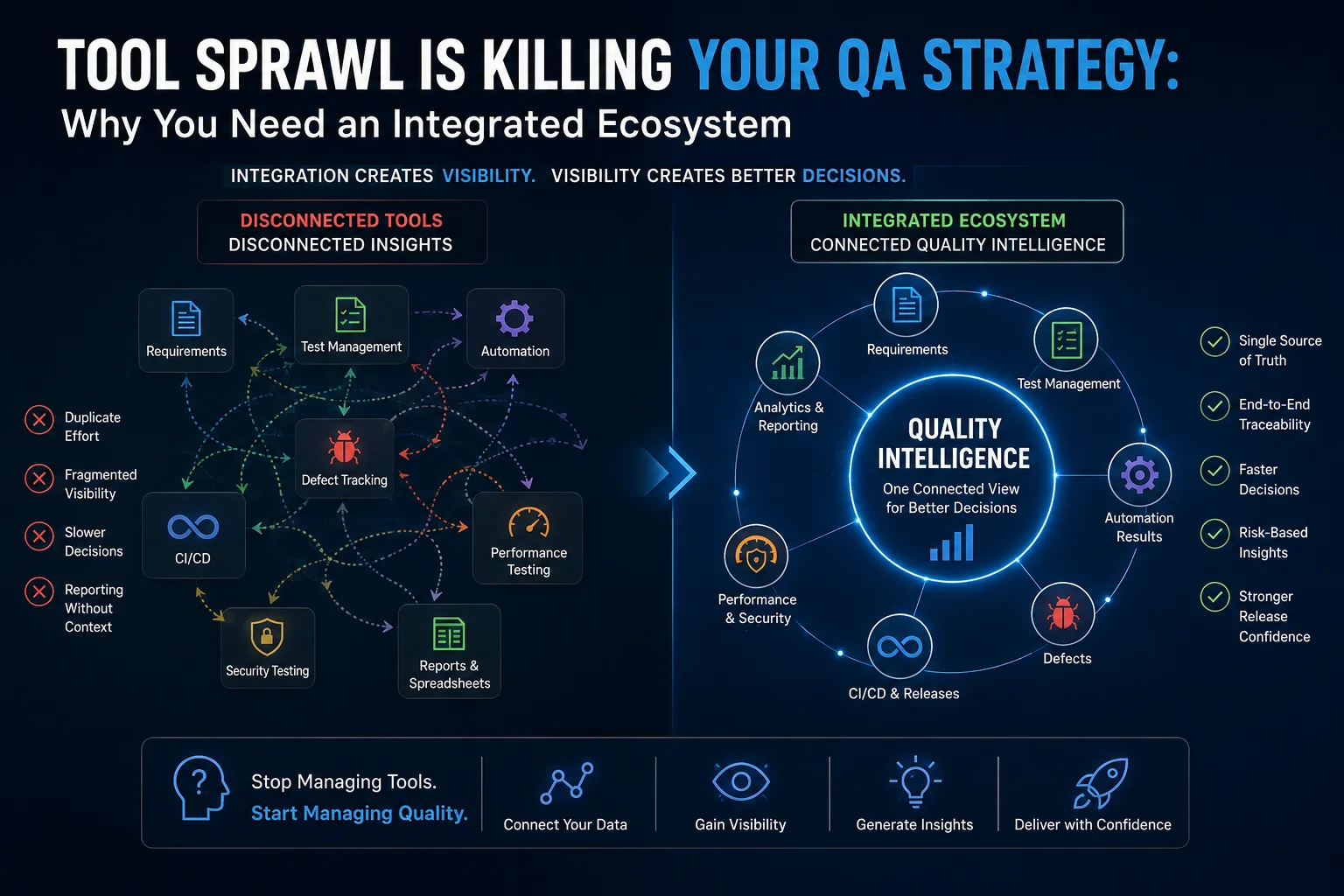
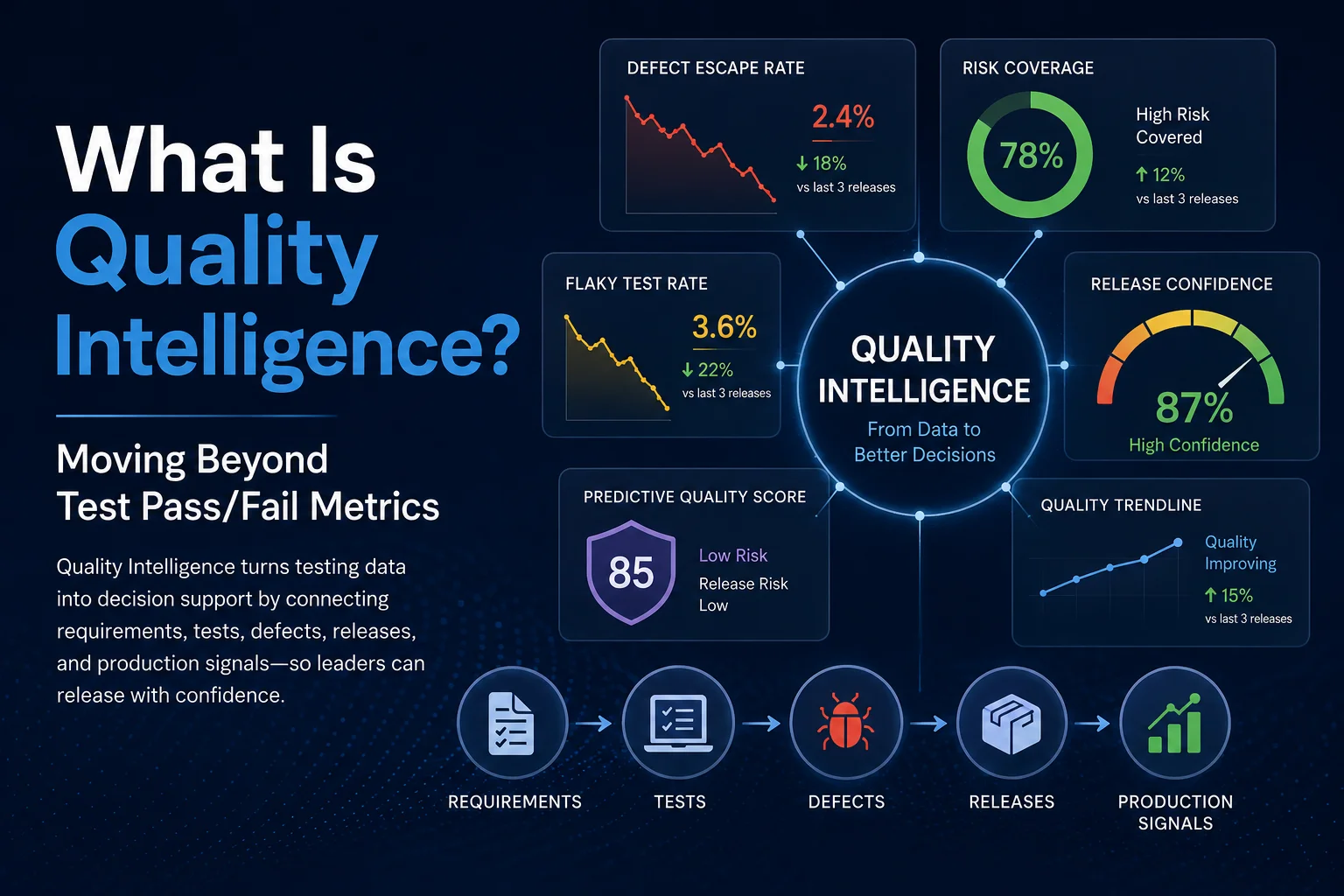
This shift is why Quality Intelligence is becoming increasingly important.
Traditional QA reporting often focuses on isolated metrics such as test pass rates, defect counts, automation coverage, or execution results.
Those numbers matter, but executives and engineering leaders need the bigger picture.
Quality Intelligence connects signals across the software delivery lifecycle to answer more meaningful questions.
Are critical requirements adequately tested?
Which code changes introduce the greatest release risk?
Where are regression coverage gaps?
Are defects increasing in a particular product area?
Which tests are becoming unreliable?
What production incidents are connected to previous quality signals?
Are we confident enough to release?
Connecting requirements, development changes, test coverage, defects, and production outcomes turns QA data into decision-making intelligence.
What QA Teams Should Do Now
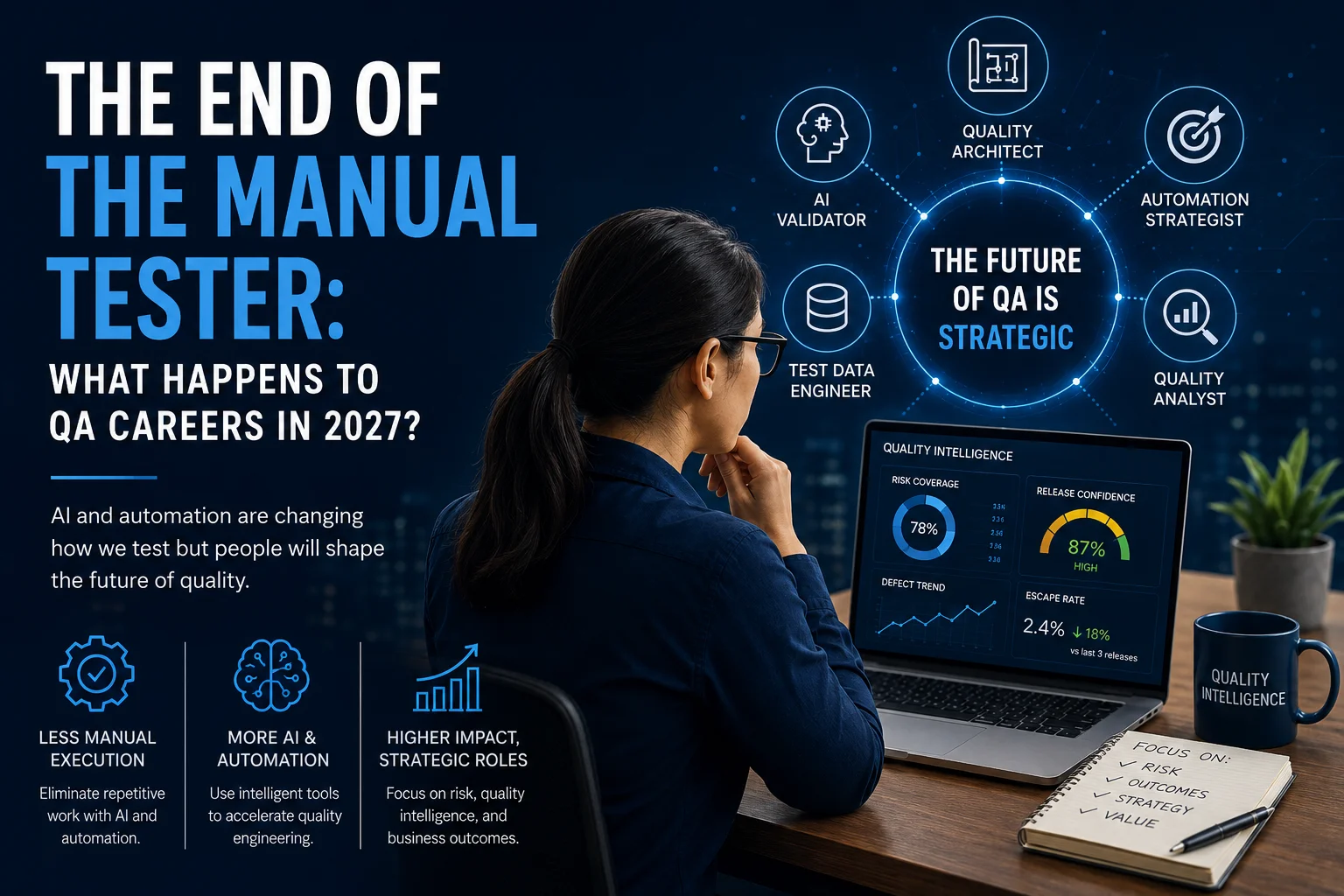
AI adoption should not mean reducing QA investment.
It should mean modernizing it.
QA leaders should evaluate whether their current quality model can keep pace with AI-assisted development.
Start by examining regression coverage across critical customer journeys. Identify where manual validation remains a release bottleneck. Review flaky automation and determine whether existing tests still provide meaningful protection.
Look at traceability as well. Teams should be able to understand how business requirements connect to tests and how code changes affect those requirements.
Finally, move beyond pass and fail reporting.
Engineering leadership needs visibility into risk, coverage, trends, and release confidence, not simply the number of tests executed.
AI Will Keep Getting Better. It Still Will Not Make Software Bug-Proof.
Future AI models will write better code.
They will understand larger codebases, identify more sophisticated issues, generate stronger tests, and provide increasingly useful development assistance.
Software will still operate in environments filled with changing requirements, unpredictable users, complex integrations, legacy systems, incomplete information, and business-specific constraints.
Those realities make perfect software an unrealistic promise.
The organizations that succeed with AI will not be the ones that assume AI eliminates quality risk.
They will be the ones that build stronger systems for understanding that risk.
The Future Is AI Development Plus Quality Intelligence
AI can dramatically accelerate software delivery.
Quality Intelligence helps organizations determine whether what they are delivering is actually ready.
That distinction will become increasingly important as AI-generated development scales.
The question for technology leaders is no longer simply:
“How much development can we automate?”
“Do our quality systems have enough intelligence to keep up?”
If AI-generated code is increasing the speed or complexity of your software delivery lifecycle, now is the time to evaluate whether your QA model is keeping pace.
Assess your regression coverage, identify quality gaps, and explore how QA Bolt can help your organization move beyond test execution toward Quality Intelligence.