Regression testing is supposed to protect every release.
But as applications grow, regression suites grow with them. More features create more test cases. More integrations create more dependencies. More releases create more opportunities for something to break.
Eventually, teams reach a point where running everything, every time, becomes difficult to sustain.
The problem is that not every feature carries the same level of risk.
A handful of critical workflows may account for a disproportionate share of production defects, customer complaints, and release delays. Meanwhile, teams continue spending valuable testing time repeatedly validating stable, low-risk functionality.
This is where the 80/20 principle becomes useful.
The exact percentages will vary from one application to another, but the principle is simple:
A relatively small portion of your application may be responsible for a large portion of your quality risk.
The goal of modern regression testing should not be to test everything equally.
It should be to understand where failure matters most and validate those areas accordingly.
Regression Testing Is Becoming a Hidden Delivery Bottleneck
Automated regression testing was designed to make software delivery faster.
For many organizations, however, the regression suite itself eventually becomes a bottleneck.
Thousands of tests may execute for every release. Some take hours to complete. Others are flaky and require investigation even when the application is functioning correctly.
As the suite expands, teams face difficult decisions.
Do we run the entire regression suite and delay the release?
Do we run only a subset and risk missing something?
Do we add more infrastructure to execute tests faster?
Do we accept longer pipelines as the cost of maintaining quality?
These questions become even more important as organizations adopt continuous delivery and AI-assisted development.
Development is getting faster. Testing cannot simply respond by running more tests.
It has to become smarter.
What Is Risk-Based Regression Testing?
Risk-based regression testing prioritizes test execution according to the likelihood and potential impact of failure.
Instead of treating every feature as equally important, teams evaluate the application through a risk lens.
A payment workflow used by thousands of customers every day should not necessarily receive the same regression priority as an internal settings page that rarely changes.
Likewise, a service that has experienced repeated production defects deserves greater attention than a stable component with little code churn and few dependencies.
Risk-based regression asks a more useful question than:
“Which tests should we run?”
It asks:
“Where would failure create the greatest risk right now?”
That shift changes regression testing from a volume exercise into a quality decision-making process.
The 80/20 Principle in Software Quality
The 80/20 rule, also known as the Pareto principle, describes situations where a relatively small number of causes account for a large proportion of outcomes.
In software quality, the ratio should not be treated as a universal mathematical rule. Your organization may find that 15% of workflows generate 60% of incidents, or that 30% of features account for most customer-reported defects.
The important insight is the concentration of risk.
Defects are rarely distributed evenly across an application.
Certain areas naturally carry greater risk because they change frequently, process critical transactions, depend on multiple systems, or have historically produced more defects.
Identifying those areas allows QA teams to allocate regression effort more intelligently.
Five Signals That Reveal Your Highest-Risk Features
To prioritize regression effectively, teams need evidence.
Several signals can help reveal where quality risk is concentrated.
1. Defect History
Past defects are one of the strongest places to begin.
Which components repeatedly generate bugs?
Which workflows are associated with production incidents?
Which areas produce the most customer support tickets?
A feature with a history of recurring defects deserves more frequent validation than one that has remained stable across dozens of releases.
The goal is not simply to count bugs. Teams should look for patterns in where defects originate, how severe they are, and whether the same areas continue to fail.
2. Code Churn
Frequently changed code introduces additional regression risk.
A feature that receives several commits every sprint has more opportunities for unintended behavior than a mature component that rarely changes.
Teams should consider changes such as new features, refactoring, dependency updates, configuration modifications, and AI-generated code.
The more frequently an area changes, the stronger the case for continuous regression coverage.
3. Business Criticality
Technical risk is only part of the equation.
Teams must also understand the business impact of failure.
Checkout, authentication, account creation, subscription management, payment processing, and other revenue or customer-critical workflows often require a higher level of protection.
A minor defect in an administrative screen and a failure in payment processing are not equivalent business events.
Your regression strategy should reflect that difference.
4. Customer Usage
High-traffic functionality deserves greater attention because more users are exposed when something goes wrong.
Usage data can help QA teams understand which workflows customers rely on most.
A feature used by 80% of customers every day may require continuous validation even if it has historically been stable.
Quality risk is not only about the probability of failure.
It is also about the potential reach of that failure.
5. Integration Complexity
Modern applications depend on APIs, third-party platforms, databases, microservices, cloud infrastructure, and external services.
The more dependencies a workflow has, the more potential failure points exist.
A seemingly small change to an API response can affect several downstream systems.
Highly interconnected workflows should therefore receive stronger regression coverage, particularly when dependencies are changing frequently.
Not Every Test Needs to Run With Every Change
This can be difficult for teams accustomed to measuring quality by the size of their regression suite.
More tests do not automatically mean better protection.
A 10,000-test regression suite can still leave critical business workflows exposed if the wrong things are being tested.
Instead, teams can organize regression coverage into different levels of priority.
High-risk workflows may need validation on every relevant code change or deployment.
Medium-risk functionality may be tested at defined pipeline stages or before major releases.
Low-risk, stable functionality may require less frequent validation, depending on changes, dependencies, and business impact.
This does not mean ignoring low-risk areas.
It means matching testing frequency and depth to actual risk.
What Smarter Regression Prioritization Looks Like
Imagine an e-commerce platform with hundreds of automated regression tests.
The traditional approach runs the entire suite before every major deployment.
But historical quality data reveals something important.
Most severe defects consistently appear in four areas:
Payment processing.
Authentication.
Checkout.
Order fulfillment integrations.
These workflows also experience frequent code changes and handle some of the platform's most important customer interactions.
A risk-based approach would prioritize those areas for continuous validation.
Stable functionality with fewer dependencies and little recent code activity could still be tested, but not necessarily with the same frequency or urgency.
The result is not less quality assurance.
It is better allocation of quality assurance.
Risk Changes From Release to Release
One of the limitations of static regression strategies is that risk does not remain constant.
A workflow considered low risk last month may become high risk after a major code change.
A previously stable integration may become vulnerable after a third-party API update.
A feature may suddenly become business critical after customer adoption increases.
This means regression prioritization cannot be a one-time exercise.
Teams need to continuously evaluate signals such as code changes, defect trends, test coverage, usage, integrations, and production incidents.
The regression strategy should evolve as the application evolves.
Where Automation Alone Falls Short
Automation is essential for modern regression testing, but automation does not automatically determine what deserves attention.
A test automation platform can execute thousands of tests efficiently.
It cannot create an effective risk strategy simply by increasing execution volume.
Teams still need to understand:
Which workflows are critical?
Where are defects escaping?
Which parts of the application are changing most frequently?
Where is coverage weakest?
Which failures would create the greatest customer or business impact?
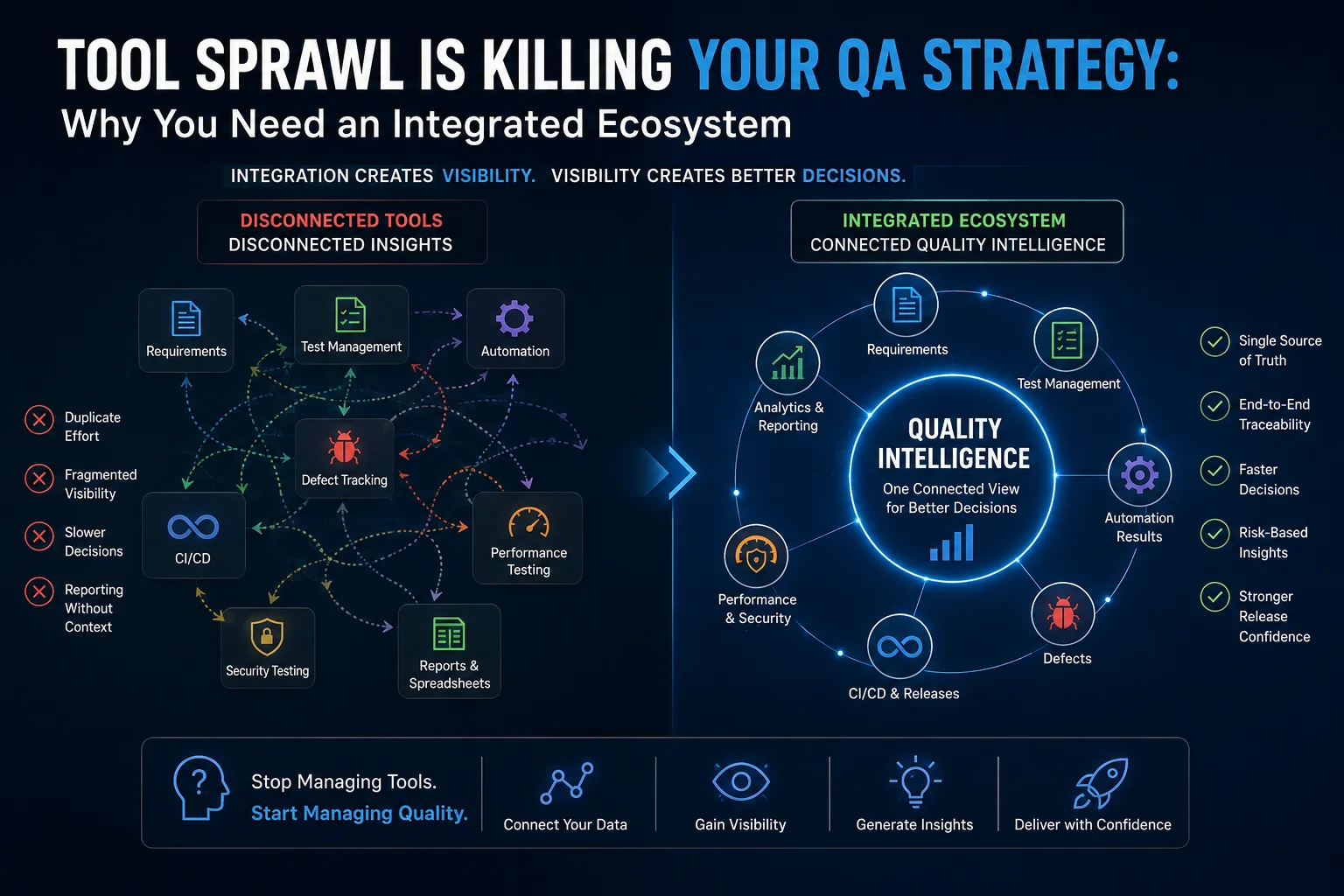
This is the difference between test automation and Quality Intelligence.
Automation executes tests.
Quality Intelligence helps teams understand what the testing data means and where attention should go next.
Quality Intelligence Makes Regression Risk Visible
Risk-based regression becomes much more powerful when quality data is connected across the software delivery lifecycle.
Instead of evaluating test results in isolation, Quality Intelligence can bring together signals from requirements, code changes, historical defects, test coverage, production incidents, and other relevant engineering data.
This creates a clearer picture of risk.
A QA leader can see that a critical payment workflow has experienced recent code churn, has unresolved defects, depends on several external services, and has gaps in automated coverage.
That workflow should probably receive immediate attention.
Another component may have strong coverage, minimal recent changes, low defect history, and limited customer exposure.
Its regression priority may be lower.
The objective is not to eliminate testing.
It is to make testing decisions more informed.
From Test Execution to Quality Intelligence
Traditional regression reporting tends to answer questions such as:
How many tests ran?
How many passed?
How many failed?
Those metrics are useful, but technology leaders increasingly need answers to broader questions:
Which areas of this release carry the greatest risk?
Are our most important customer journeys adequately protected?
Where are regression gaps increasing?
Which failures could have the greatest business impact?
Can we release with confidence?
That is where Quality Intelligence changes the conversation.
Instead of simply reporting test execution, teams can connect quality signals to release risk and business impact.
How QA Leaders Can Apply the 80/20 Principle
Start with your historical quality data.
Review production defects, customer-reported issues, release delays, code changes, and regression failures. Identify where problems repeatedly concentrate.
Then map those patterns against business criticality and customer usage.
Look closely at integration complexity and automated test coverage.
You may discover that a relatively small group of workflows consistently represents the greatest quality exposure.
Those areas should become the foundation of your high-priority regression strategy.
From there, testing frequency can be adjusted based on evidence rather than habit.
The goal is not to reduce regression testing simply to make pipelines faster.
The goal is to reduce unnecessary testing while strengthening validation where failure matters most.
The Future of Regression Is Risk-Based
Software development is accelerating.
AI-assisted coding, continuous delivery, distributed architectures, and increasingly complex integrations are creating more changes for QA teams to validate.
Running everything all the time will not always be the most effective response.
The future of regression testing is intelligent prioritization.
Teams need to know which workflows deserve continuous validation, which risks are increasing, where coverage is weakening, and where testing resources will have the greatest impact.
That requires more than automation.
It requires intelligence.
Final Thoughts
The 80/20 principle is not about proving that exactly 80% of your defects come from exactly 20% of your application.
It is about recognizing that software risk is rarely distributed evenly.
Some workflows matter more.
Some change more frequently.
Some fail more often.
Some create far greater consequences when they break.
A mature regression strategy recognizes those differences and uses them to guide testing decisions.
If your regression suite is getting larger while release confidence remains unchanged, it may be time to evaluate whether you are testing more or simply running more tests.
Assess your current regression coverage, identify where your greatest quality risks are concentrated, and explore how QA Bolt can help your organization move from test execution to Quality Intelligence.