Most QA teams do not have a tooling problem because they lack tools.
They have a tooling problem because they have too many disconnected ones.
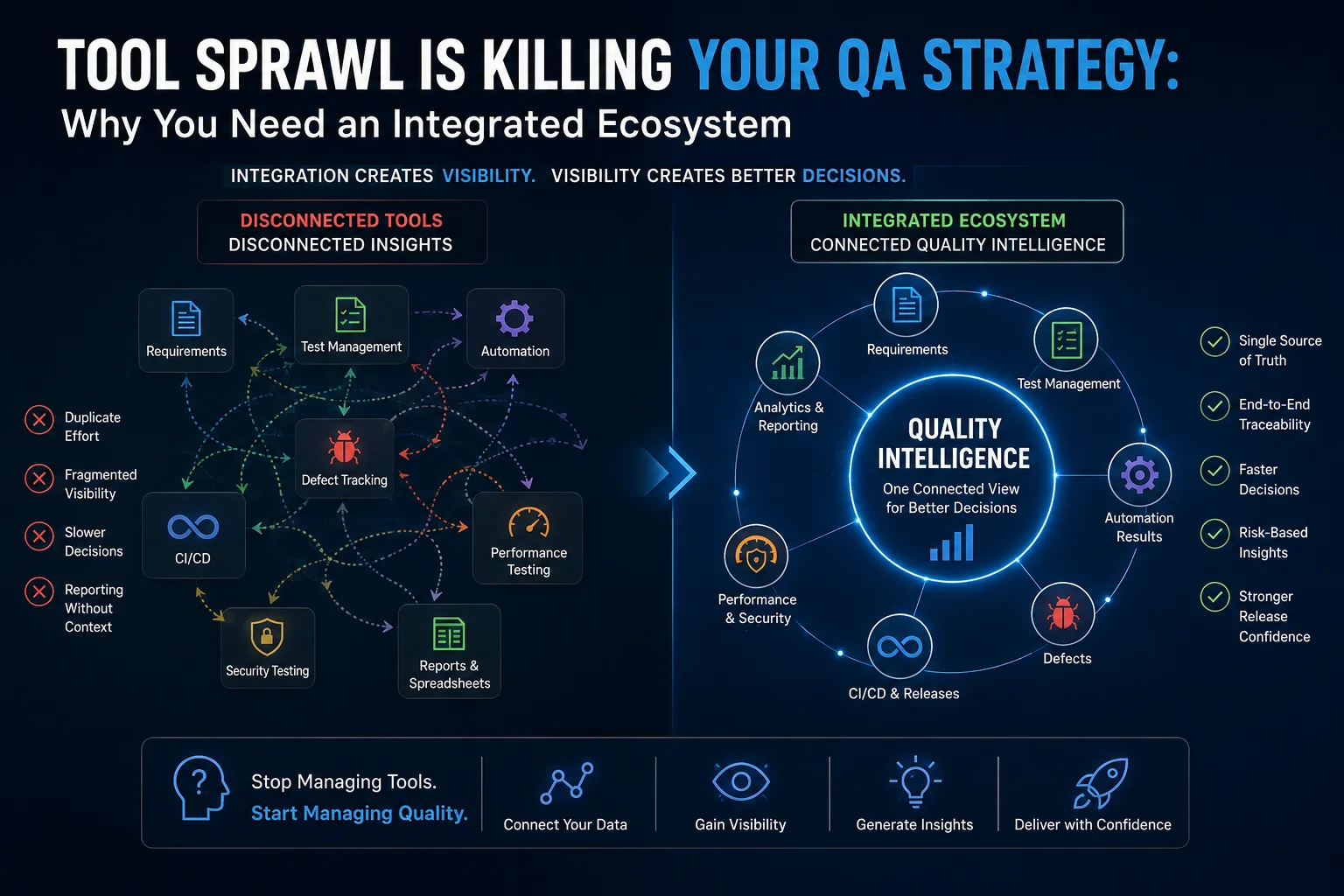
Test cases live in one platform. Automation results live somewhere else. Defects are tracked in Jira or Azure DevOps. CI/CD pipelines generate their own data. Requirements sit in another system. Release reports are often assembled manually in spreadsheets.
Every tool may be doing its job.
But together, they may not be giving leaders the one thing they actually need:
A clear view of software quality and release risk.
This is the hidden cost of tool sprawl.
The problem is not simply having too many platforms. The problem is having quality data spread across systems that do not provide a connected view of what is happening.
More tools can generate more data.
Integration turns that data into intelligence.
When More Tools Create More Work
Modern QA organizations have access to an enormous ecosystem of technology.
There are platforms for:
-
Requirements management
-
Test management
-
Test automation
-
Defect tracking
-
CI/CD
-
Performance testing
-
Security testing
-
Monitoring
-
Analytics
-
Reporting
Individually, these tools can improve productivity.
But as the technology stack expands, teams often create another problem.
Someone still has to connect everything.
QA engineers switch between platforms to understand failures. Managers export results into spreadsheets. Release teams manually compare defects with test results. Engineering leaders ask multiple teams for status updates before deciding whether a release is ready.
The tools may be automated.
The decision-making process often is not.
The Real Cost of Tool Sprawl
Tool sprawl creates more than inconvenience.
It can directly affect productivity, visibility, and release confidence.
Duplicate Effort
When systems are disconnected, teams frequently enter, export, transform, or reconcile the same information multiple times.
A requirement may be documented in one platform, connected manually to a test case in another, linked to a defect somewhere else, then summarized again for release reporting.
The organization ends up spending valuable time managing quality information instead of improving quality.
Fragmented Visibility
Every platform creates its own version of the truth.
The automation dashboard may show a strong pass rate.
The defect platform may show several critical issues.
The CI/CD pipeline may be green.
Production monitoring may show increasing instability.
Which signal should leadership trust?
Without integration, leaders are forced to interpret quality through isolated snapshots.
That makes it difficult to understand the complete risk picture.
Slower Decisions
When information must be collected manually, release decisions take longer.
Teams spend time asking questions such as:
Where are the latest results?
Which defects affect this release?
Did the failed tests cover critical functionality?
Are those failures new?
What changed since the last build?
Are we actually ready to release?
The information often exists.
It simply is not connected.
Reporting Without Context
Dashboards can create the appearance of visibility without providing meaningful insight.
A report might show:
96% of tests passed.
But leadership still needs to know:
Which 4% failed?
What business functionality do those failures affect?
Are the failures related to recent changes?
Are critical workflows fully covered?
Is the release risk increasing or decreasing?
Reporting becomes valuable when data is connected to business and engineering context.
You Do Not Necessarily Need Fewer Tools
The answer to tool sprawl is not automatically consolidation.
Different engineering teams have different requirements, workflows, technologies, and existing investments.
A specialized automation framework may be excellent at automation.
A defect platform may be excellent at issue management.
A CI/CD platform may be excellent at deployment orchestration.
Replacing every system with one platform can introduce a different set of problems.
The better goal is not:
One tool for everything.
It is:
One connected quality ecosystem.
The individual tools can continue doing what they do best, while an integrated quality layer connects their data into a shared view.
What an Integrated Quality Ecosystem Looks Like
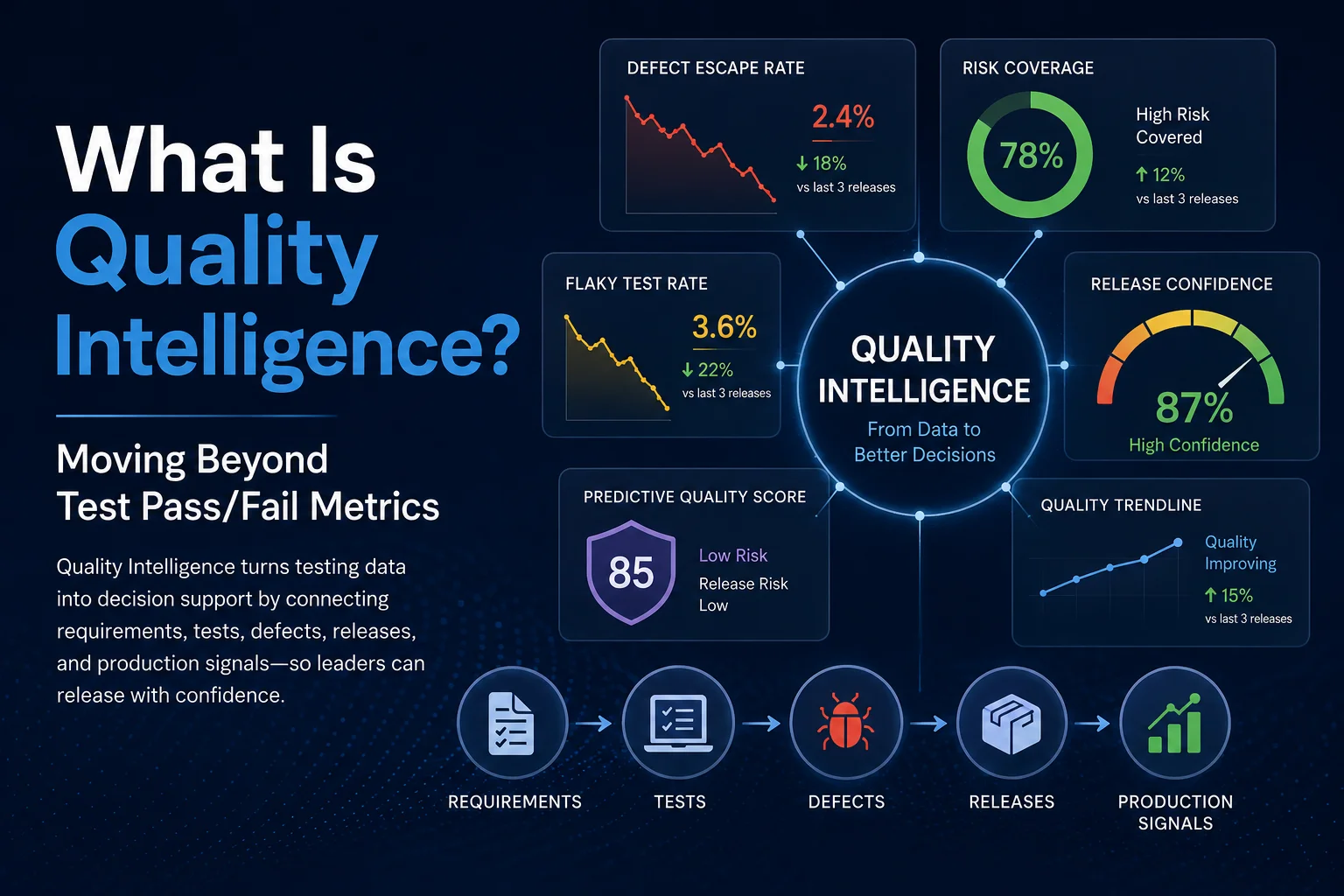
An integrated quality ecosystem connects the major signals involved in software delivery.
Requirements show what the system is expected to do.
Tests show how those requirements are being validated.
Automation provides continuous execution and regression evidence.
Defects reveal where quality is breaking down.
CI/CD data shows what is changing and when.
Release information provides deployment context.
Production signals reveal what customers are actually experiencing.
When these signals are connected, teams can begin answering more meaningful questions.
Which requirements have insufficient test coverage?
Which defects repeatedly escape into production?
Which automated tests are unreliable?
Which recent changes affect high-risk functionality?
Where are the biggest regression gaps?
How has release confidence changed over time?
That is where QA moves beyond managing tools and starts managing quality risk.
Integration Creates Visibility
Visibility is not the number of dashboards an organization has.
Visibility means being able to understand what is happening without manually assembling the story.
Consider a failed automated test.
In a disconnected environment, someone may need to open the automation platform, find the failure, check the defect system, review the requirement, investigate the code change, and determine whether the failure affects the release.
In an integrated ecosystem, those relationships can be connected.
The team can understand:
What failed. Why it matters. What changed. What risk it creates. What action should happen next.
That is a much more useful quality signal.
From Integration to Quality Intelligence
Integration is valuable because it creates visibility.
But visibility is only the beginning.
Once quality data is connected, organizations can start identifying patterns across releases, tests, defects, and production outcomes.
They can track:
Instead of asking teams to interpret multiple dashboards, leaders can begin using quality information to support decisions.
This is the transition from quality data to Quality Intelligence.
The question changes from:
"What happened in our tests?"
to:
"What does our quality data tell us about this release?"
Where TestFlow Fits
QA Bolt's approach is built around connecting quality rather than treating testing as an isolated activity.
TestFlow, combined with QA Bolt's modern automation framework, can help create a Quality Intelligence layer across the software delivery lifecycle.
Requirements, tests, defects, releases, automation results, and analytics can become part of a more connected quality ecosystem.
The goal is not simply to give teams another tool.
It is to help organizations get more value from the tools and quality data they already have.
With stronger integration, QA teams can reduce manual reporting, improve traceability, identify coverage gaps, and give engineering leaders greater visibility into release risk.
That turns the quality ecosystem from a collection of platforms into a source of decision support.
Stop Managing Tools. Start Managing Quality.
A large technology stack does not automatically create a mature QA organization.
Neither does another dashboard.
The real question is whether your tools work together well enough to answer the questions that matter.
Where is the risk?
What is covered?
What is missing?
What is changing?
What should we prioritize?
Are we confident enough to release?
When quality information is fragmented, answering those questions requires manual effort and interpretation.
When the ecosystem is connected, teams gain visibility.
And when that visibility is transformed into insight, organizations gain Quality Intelligence.
Is Your QA Ecosystem Giving You the Full Picture?
If your teams are switching between multiple systems, manually building reports, or struggling to connect testing activity with release risk, your QA strategy may have an integration gap.
QA Bolt helps organizations evaluate their current QA model, identify regression coverage gaps, modernize automation, and connect quality signals through an integrated approach to Quality Intelligence.
Take the FREE Quality Maturity Assessment to understand where your QA organization stands today and identify opportunities to move from disconnected test execution to connected quality decisions.
Beyond Testing. Powered by Quality Intelligence.