For years, software quality has been summarized by a familiar set of numbers:
How many tests passed?
How many failed?
How many defects are open?
What percentage of our tests are automated?
These metrics are useful. But they do not answer the question engineering and business leaders ultimately care about:
Are we confident enough to release?
A 98% test pass rate might look reassuring. But what if the remaining 2% covers a critical payment workflow? What if an important customer journey was never tested? What if dozens of passing tests are flaky, redundant, or disconnected from the areas of the application that changed most?
A green dashboard does not automatically mean a low-risk release.
That gap between test results and release decisions is where Quality Intelligence comes in.
What Is Quality Intelligence?
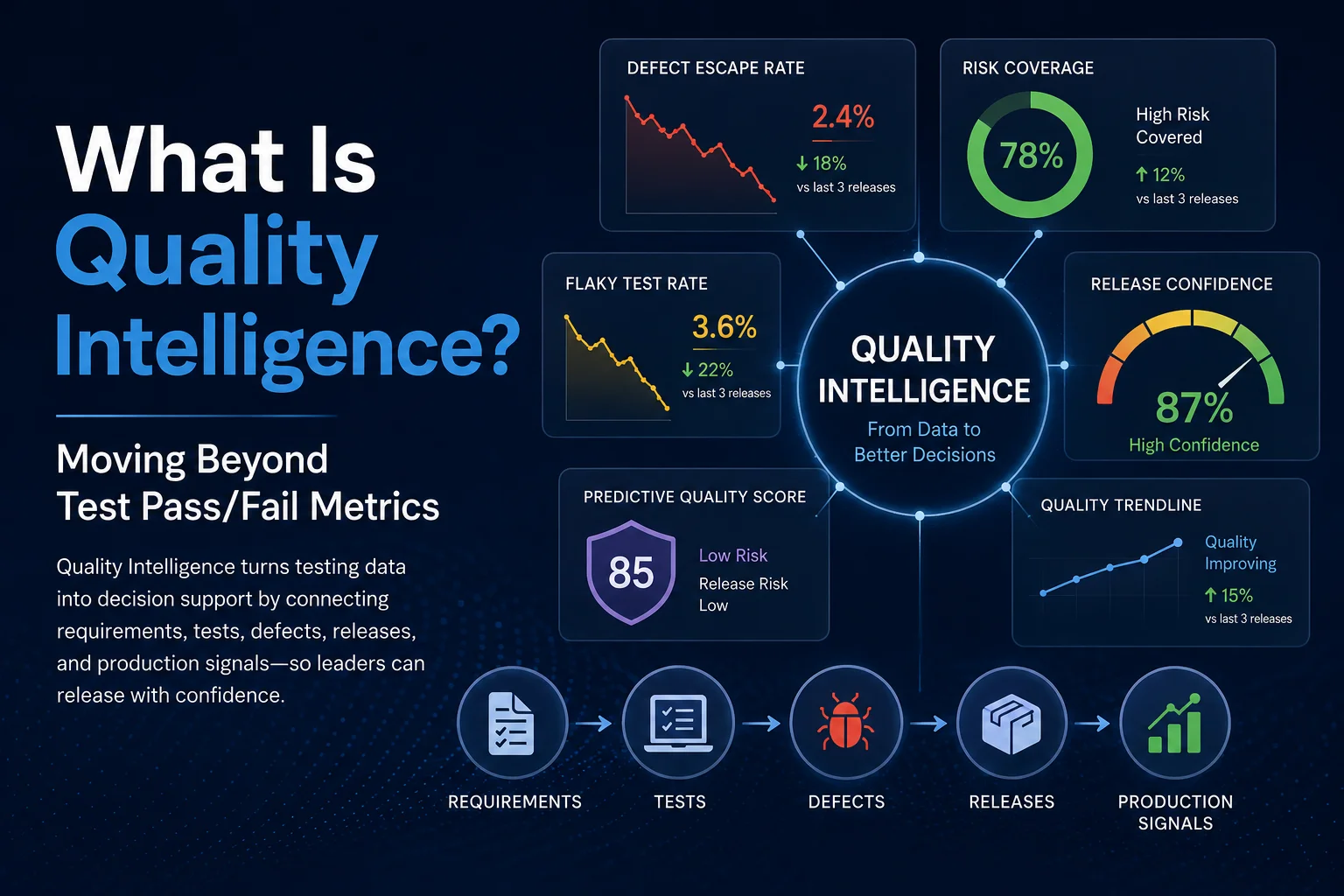
Quality Intelligence is the practice of turning software quality data into actionable decision support.
Instead of viewing requirements, tests, defects, releases, and production incidents as separate sources of information, Quality Intelligence connects them to create a more complete picture of software quality and business risk.
Traditional QA reporting tells teams what happened.
Quality Intelligence helps them understand:
-
What was actually covered?
-
What remains untested?
-
Where is risk increasing?
-
Which failures matter most?
-
Are we becoming more or less stable over time?
-
What should we test next?
-
Are we ready to release?
The difference is significant.
Testing generates data. Quality Intelligence gives that data context.
And context is what allows engineering leaders to make better decisions.
Why Pass/Fail Metrics Are No Longer Enough
Imagine a regression suite containing 5,000 automated tests.
The latest run reports:
4,900 passed.
100 failed.
98% pass rate.
Is the release ready?
There is no responsible way to answer that question from the pass rate alone.
The 100 failures could be low-priority issues with little customer impact. Or five of them could affect authentication, checkout, payments, or another critical business workflow.
The 4,900 passing tests could provide excellent coverage. Or hundreds could be testing the same functionality while a newly modified service has almost no regression coverage.
Pass/fail reporting measures test execution.
It does not necessarily measure risk.
That is the fundamental shift behind Quality Intelligence: moving from measuring how much testing occurred to measuring how much confidence that testing actually provides.
From Test Metrics to Quality Metrics
Quality Intelligence does not mean abandoning traditional QA metrics. It means putting them into a larger context.
Instead of relying heavily on test counts and pass percentages, organizations can begin measuring indicators that more closely reflect software health and release risk.
1. Defect Escape Rate
Defect escape rate measures how many defects make it beyond the stage where they should have been detected, particularly those that reach production.
This tells leaders something a test pass rate cannot:
How effective is our quality process at protecting customers?
A team can execute thousands of automated tests and still have a serious quality problem if customer-impacting defects regularly escape into production.
Tracking defect escapes over time can reveal weaknesses in regression coverage, test strategy, requirements, environments, or release governance.
The goal is not simply to find more bugs.
It is to find the right bugs before customers do.
2. Risk Coverage
Traditional coverage metrics often tell teams how much code or functionality has been tested.
Risk coverage asks a more important question:
How much of our business-critical risk is actually protected?
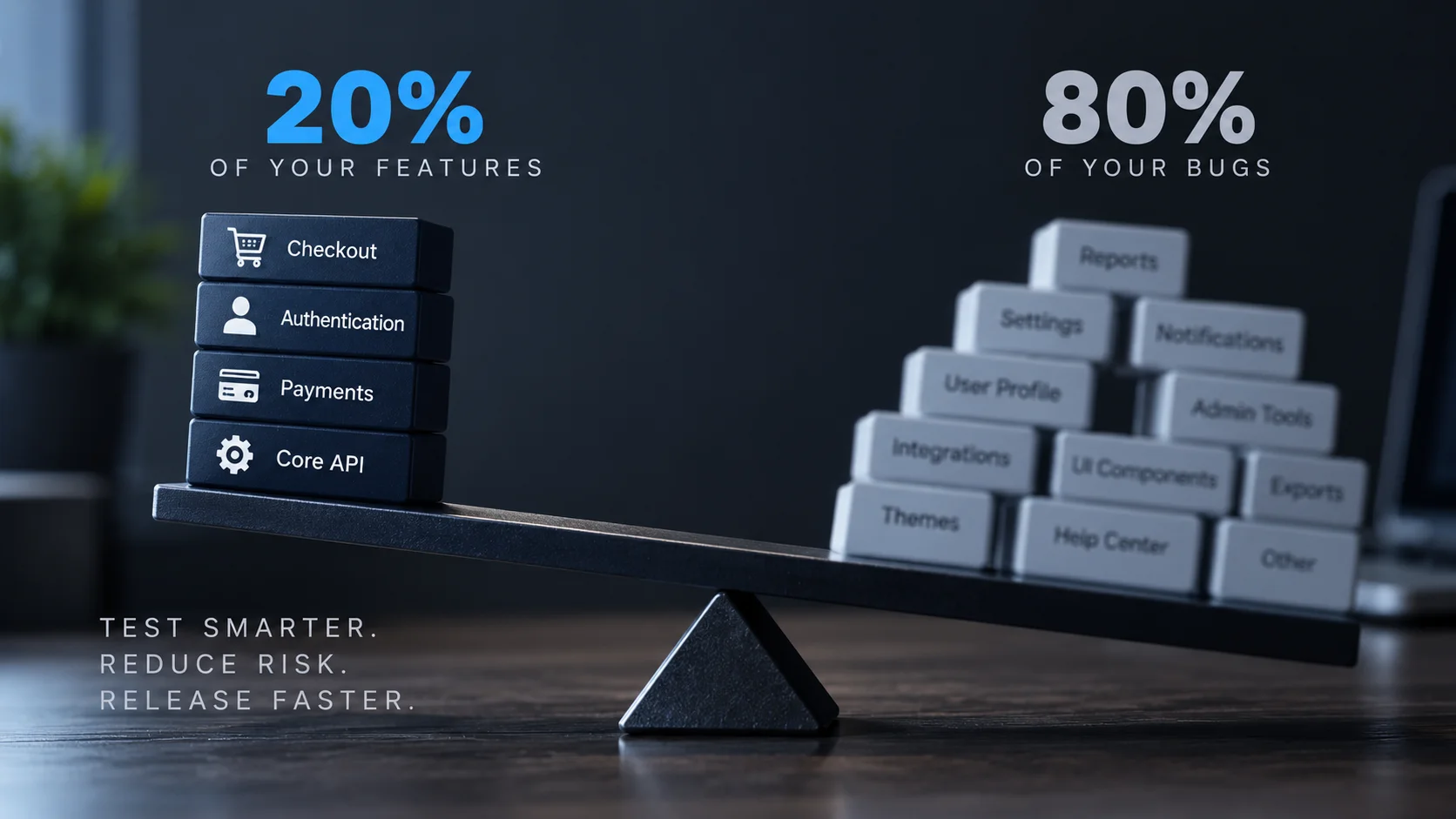
Consider two workflows:
Both may represent functionality that requires testing, but they do not carry the same business consequences if they fail.
Quality Intelligence connects testing activity to business criticality, system changes, defect history, customer impact, and other risk signals.
That allows teams to prioritize coverage around the areas where failure matters most.
The goal is not necessarily 100% coverage everywhere.
The goal is strong coverage where the business has the most to lose.
3. Flaky Test Rate
Automation is supposed to increase confidence.
Flaky automation does the opposite.
When tests fail inconsistently without an actual product defect, engineering teams eventually stop trusting the results. Failures get rerun instead of investigated. Red builds become background noise.
Tracking flaky test rate helps reveal whether the automation suite is functioning as a reliable quality signal.
Because if engineers cannot trust a failed test, the organization cannot confidently use automation to support release decisions.
Quality Intelligence therefore looks beyond how many tests are automated and asks whether those tests are stable, meaningful, and trustworthy.
4. Release Confidence
Release confidence brings multiple quality signals together to answer one of the most important questions in software delivery:
How confident should we be in this release?
Instead of making that decision based on a single pass percentage, release confidence can consider factors such as:
-
Regression coverage
-
Coverage of recently changed functionality
-
Open defect severity
-
Defect escape trends
-
Test stability
-
Requirement traceability
-
Critical business workflow coverage
-
Production health
-
Historical failure patterns
This creates a more objective view of readiness.
A release is no longer considered ready simply because "QA passed it."
Leaders can see the evidence behind the decision.
5. Quality Trendlines
A snapshot tells you what is happening today.
A trend tells you where you are going.
Quality Intelligence looks across releases and development cycles to identify whether software quality is improving, declining, or becoming more unpredictable.
For example:
Are defect escapes increasing release over release?
Is regression stability deteriorating?
Are certain services repeatedly responsible for production incidents?
Is test coverage keeping pace with product development?
Are releases becoming more or less risky?
These patterns can be difficult to see when quality data is scattered across different tools and teams.
Once connected, quality becomes something organizations can manage proactively instead of reviewing only after something goes wrong.
6. Predictive Quality Scoring
The next evolution of Quality Intelligence is moving from describing risk to anticipating it.
Predictive quality scoring combines historical and current quality signals to identify where problems are most likely to occur.
Changes to historically unstable components, declining coverage, recurring defect patterns, code change frequency, test failures, and production signals can all contribute to a more dynamic view of risk.
Instead of treating every part of an application equally, teams can identify areas that deserve additional testing or investigation before release.
The question changes from:
"Did our tests pass?"
to:
"Based on what we know, where is this release most likely to fail?"
That is a much more valuable question.
Connecting the Entire Quality Picture
Quality Intelligence becomes powerful when organizations stop treating quality information as isolated data.
Requirements may live in one platform.
Automated tests in another.
Defects somewhere else.
CI/CD results in another system.
Production monitoring in yet another.
Individually, each system tells part of the story.
Quality Intelligence connects those signals so teams can understand relationships between them.
A business requirement can be connected to its test coverage. A code change can be connected to historical defects. A failed test can be evaluated against business risk. A production incident can expose a regression coverage gap that influences future testing.
Quality becomes a continuous feedback loop rather than a final checkpoint before deployment.
Quality Intelligence Changes the Leadership Conversation
This shift matters beyond the QA organization.
A QA Manager may need to know which regression tests are unstable.
A VP of Engineering needs to know whether that instability puts the release at risk.
A CIO may need to understand whether quality issues are affecting operational resilience, customer experience, or strategic delivery.
Different leaders need different levels of information.
Quality Intelligence creates a common language between them.
Instead of reporting:
"98% of our tests passed."
quality teams can communicate:
"Our highest-risk customer journeys are covered, no critical defects remain open, regression stability is improving, and this release has strong evidence supporting deployment."
Or, just as importantly:
"The test pass rate is high, but two critical workflows have insufficient coverage. We recommend holding the release until those risks are validated."
That is no longer test reporting.
That is decision support.
Moving From Reactive QA to Predictive Quality
Traditional QA has largely been reactive.
Build the software. Run the tests. Find the defects. Fix them. Repeat.
Quality Intelligence creates an opportunity to become more proactive.
By connecting quality signals over time, organizations can begin identifying risk before it becomes a production issue.
Teams can prioritize testing around high-risk changes.
Engineering leaders can identify deteriorating quality earlier.
Release decisions can rely on evidence rather than instinct.
And QA can evolve from the team responsible for validating software into a function that helps the organization understand and manage software risk.
The Question Is No Longer "Did the Tests Pass?"
Software development is becoming faster, more automated, and increasingly AI-assisted.
Quality strategies must evolve with it.
Running more tests will not solve every quality problem.
Neither will achieving a higher automation percentage or producing another dashboard full of pass/fail metrics.
Organizations need to understand what their testing data actually means.
What is covered?
What is not?
Where is risk increasing?
What should we test next?
And do we have enough evidence to confidently release?
That is the promise of Quality Intelligence.
It turns testing data into business context, business context into risk insight, and risk insight into better decisions.
Because the real measure of software quality is not how many tests passed.
It is how confidently you can decide what happens next.
Move Beyond Test Execution
If your QA reporting still revolves primarily around test counts, pass rates, and open defects, it may be time to evaluate what those metrics are actually telling you.
QA Bolt helps organizations connect Quality Engineering, Quality Governance, and Quality Intelligence to uncover regression coverage gaps, understand software risk, and make release decisions with greater confidence.
Take the Free Quality Maturity Assessment to evaluate your current QA model, identify gaps in your regression and quality strategy, and see where your organization can move from test execution toward Quality Intelligence.
Beyond Testing. Powered by Quality Intelligence.