For decades, Quality Assurance has faced a unique challenge that few other engineering disciplines experience. When software quality is poor, everyone notices. Production outages make headlines, failed releases delay business initiatives, security vulnerabilities create risk, and customer complaints quickly reach executive leadership. In those moments, QA is often the first organization asked what went wrong.
Ironically, when Quality Engineering performs exceptionally well, almost nobody notices.
Applications work as expected. Customers complete transactions without interruption. Releases happen on schedule. Revenue continues to grow. Software simply performs the way it should.
The better a Quality Engineering organization becomes, the less visible its contributions often appear. This creates one of the greatest leadership challenges facing QA today: demonstrating value before something goes wrong.
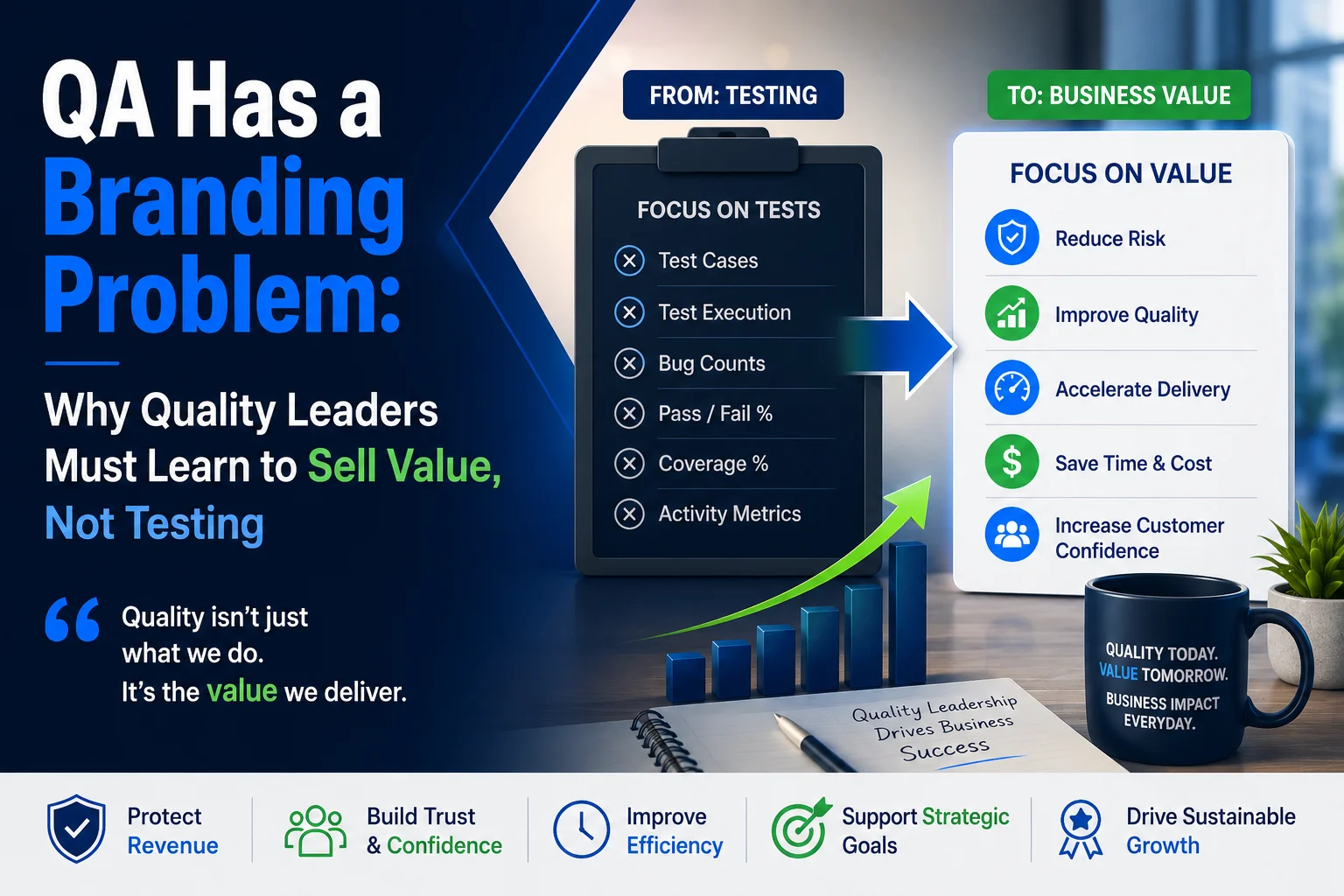
QA Doesn't Have a Quality Problem. It Has a Perception Problem.
Most executive leadership teams rarely think about automated regression testing, API testing, UI automation, or test coverage percentages. Those metrics are important to engineering teams, but they don't directly answer the questions business leaders are asking.
Executives are focused on outcomes such as:
- Revenue growth
- Customer retention
- Operational risk
- Regulatory compliance
- Brand reputation
- Product delivery speed
Unfortunately, many QA organizations continue presenting technical testing metrics while executives are evaluating business performance. That disconnect often causes quality organizations to be viewed as operational support teams rather than strategic business partners.
If QA wants a seat at the executive table, it must begin speaking the language of business.
Stop Reporting Testing Activity And Start Reporting Business Impact
Consider a typical QA status report.
It might include statistics such as:
- 4,200 automated tests executed
- 97.8% automation pass rate
- 18 new defects identified
- 14 defects resolved
While technically accurate, none of these numbers answer the question executives actually care about:
"Is the business protected?"
Now imagine delivering the same update differently.
Instead of discussing test execution, your report communicates measurable business outcomes:
- 92% of revenue-generating customer workflows have been fully validated.
- Regression automation eliminated approximately 140 hours of manual testing this sprint.
- Early API validation reduced production integration defects by 38%.
- Release risk remains low with no critical customer-impacting scenarios identified.
The conversation immediately changes. Instead of reporting activity, QA is demonstrating business value.
Every QA Budget Should Read Like a Business Case
One of the biggest mistakes quality leaders make is justifying investments based on workload instead of outcomes.
It's common to hear statements like:
"We need three additional automation engineers."
That request immediately sounds like another expense.
Now frame the same request differently.
Three additional Quality Engineers would allow the organization to:
- Reduce regression execution from eight hours to less than two.
- Increase release frequency without increasing operational risk.
- Improve developer productivity by eliminating manual testing bottlenecks.
- Reduce escaped production defects through broader automation coverage.
- Accelerate customer feature delivery by shortening validation cycles.
The request is no longer about headcount.
It's about enabling faster innovation while reducing business risk.
Executive leadership invests in business outcomes and not testing activity.
The Best QA Leaders Understand Business Economics
Modern QA leadership requires more than technical expertise. It also requires financial awareness.
Every software quality decision has a measurable business impact.
Every production defect carries a cost.
Every hour of application downtime affects revenue and customer trust.
Every delayed release postpones new business capabilities.
Strong QA leaders understand the financial implications behind software quality. They ask questions such as:
- How much revenue does this application generate each hour?
- What is the cost of one production outage?
- How much manual effort could automation eliminate?
- What financial impact does a delayed release have on the business?
When quality leaders understand these answers, they stop discussing testing costs and begin discussing business investment.
Executive Dashboards Should Answer Executive Questions
Engineering teams already have access to countless operational dashboards.
Velocity.
Sprint completion.
Deployment frequency.
Defect counts.
These are valuable engineering metrics, but executive leadership needs a different perspective.
An executive quality dashboard should answer questions such as:
- What is our overall Release Readiness score?
- Which business-critical applications carry the highest operational risk?
- Where do our largest test coverage gaps exist?
- How much release risk has decreased over the last quarter?
- How much engineering capacity has automation returned to development teams?
- Which customer journeys represent our highest business risk?
This is where Quality Intelligence becomes far more valuable than traditional QA reporting. It transforms testing data into executive decision support.
Leadership Is Built Long Before Budget Season
Technical expertise alone rarely secures additional investment.
Influence does.
The strongest QA leaders build relationships across the organization long before they need executive approval for new initiatives.
They regularly collaborate with:
- Product Management
- Engineering Leadership
- Enterprise Architecture
- Security
- DevOps
- Customer Support
- Operations
Not because there's a problem to solve, but because software quality impacts every one of these groups.
By consistently demonstrating value across the organization, QA becomes a trusted advisor rather than a department requesting additional resources.
AI Won't Replace QA Leaders, but It Will Raise the Standard for Leadership
Artificial Intelligence is already transforming software development.
AI can generate test cases, write automation scripts, summarize defects, create documentation, and optimize regression suites in seconds.
These capabilities will dramatically improve engineering productivity.
They will not replace leadership.
In fact, AI makes leadership even more important.
Future quality leaders will be expected to answer questions AI cannot:
- What do these quality trends mean?
- Which engineering investments should we prioritize?
- What business risks remain?
- Is this software truly ready for production?
Execution can increasingly be automated.
Judgment cannot.
Questions Every QA Leader Should Ask
Before your next executive meeting, take a moment to reflect on these questions:
- Can I explain QA's value without mentioning testing?
- Do I understand how software quality impacts revenue and customer experience?
- If my budget doubled tomorrow, could I clearly justify the expected return on investment?
- Would my CIO describe QA as a cost center or a strategic partner?
- Am I reporting engineering activity or influencing business decisions?
The answers reveal far more about leadership maturity than any automation metric ever will.
Final Thoughts
The future of QA leadership will not be defined by the size of your team, the number of automated tests you own, or even the number of defects your organization identifies.
It will be defined by your ability to connect software quality with measurable business value.
The most influential quality leaders won't simply improve testing. They'll improve engineering productivity, reduce operational risk, accelerate software delivery, and provide executives with the confidence to make faster, better-informed decisions.
When executive leadership stops asking,
"How many tests did QA execute?"
and starts asking,
"How much business risk did Quality Engineering eliminate?"
quality is no longer viewed as a support function.
It becomes a strategic business advantage.