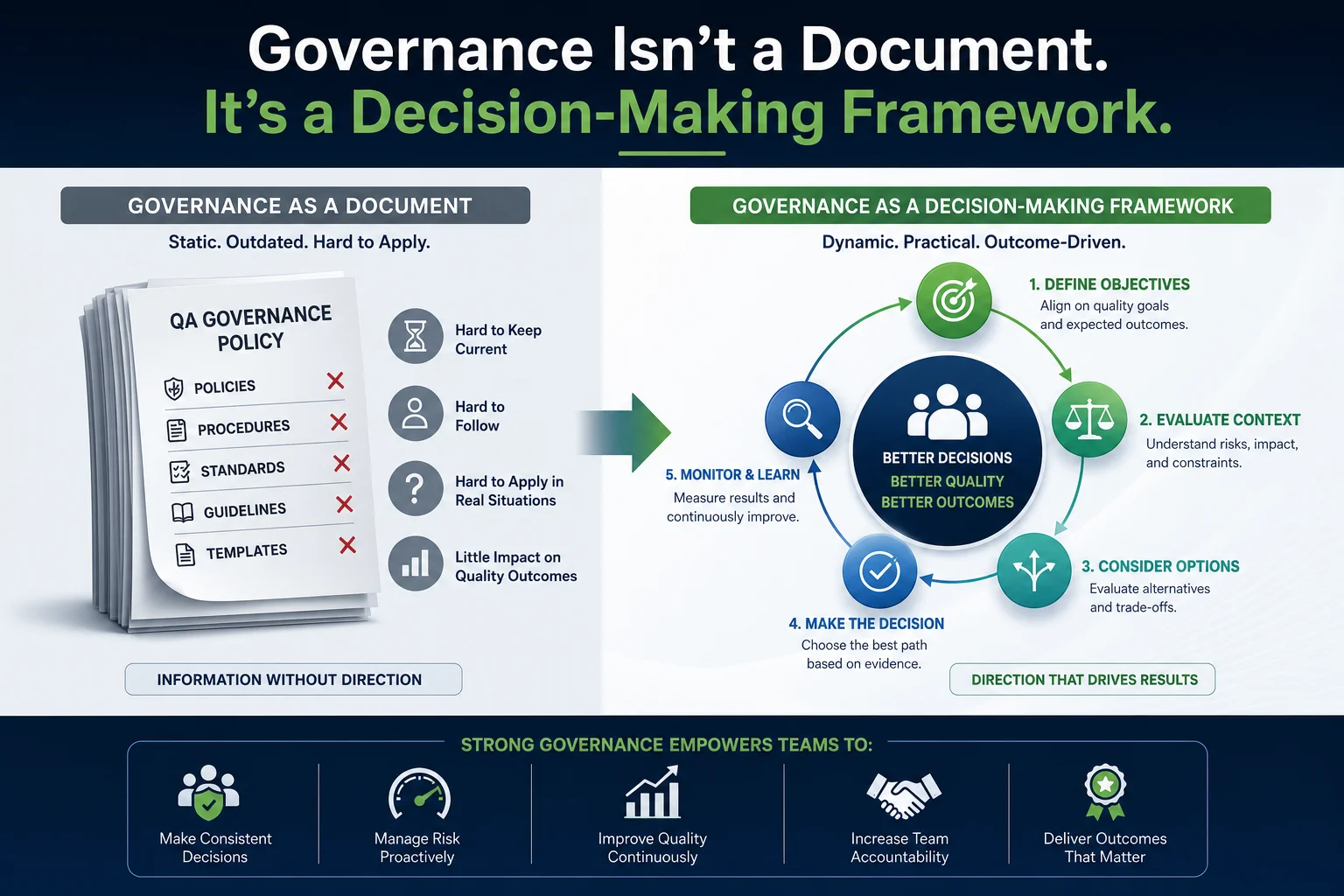
Governance Isn't a Document. It's a Decision-Making Framework.
Ask ten engineering organizations whether they have Quality Governance, and nine will answer "yes."
Ask them to explain how they decide whether software is truly ready for production, and the answers become much less clear.
Some rely on a spreadsheet.
Others require an email approval.
Some hold a weekly Go/No-Go meeting.
Others simply trust that if automated tests pass, the software must be ready.
Those aren't governance models.
They're release rituals.
True Quality Governance isn't measured by the number of meetings, approval signatures, or compliance checklists.
It's measured by whether engineering leaders can make consistent, evidence-based decisions every time software moves through the delivery pipeline.
Passing Tests Doesn't Mean You're Ready to Release
One of the most dangerous assumptions in software delivery is believing that a successful regression suite automatically means a successful release.
Imagine a release where:
- 98% of automated tests pass.
- No critical defects are open.
- Performance testing completes successfully.
- Security scans show no major vulnerabilities.
Most organizations would approve the deployment.
But what if:
- The newest customer workflow was never automated?
- A recently modified API was excluded from testing?
- The mobile application received only partial regression coverage?
- Accessibility testing was skipped because of time constraints?
- One critical business requirement was never validated?
Technically, the release "passed."
From a governance perspective, it failed.
Quality Governance doesn't ask, "Did the tests pass?"
It asks, "Do we have sufficient evidence to release with confidence?"
The Hidden Gaps Most Organizations Never Measure
Many engineering teams measure activity instead of effectiveness.
They proudly report:
- Number of automated tests
- Number of executions
- Code coverage percentages
- Defect counts
These metrics are useful, but incomplete.
The more important questions often go unanswered:
- Which requirements remain unvalidated?
- Which business capabilities have the highest risk?
- Where are automation coverage gaps increasing?
- Which applications generate the most escaped defects?
- Which teams consistently release with the highest confidence?
Without these answers, leadership has visibility into testing, but not into software quality.
Governance Begins Long Before the First Test Runs
Many organizations introduce governance during User Acceptance Testing or just before production deployment.
By then, most architectural decisions have already been made.
Quality Governance should begin when the project begins.
A mature governance model introduces quality checkpoints throughout the Software Development Life Cycle.
Modern Governance Lifecycle
|
SDLC Phase
|
Governance Objective
|
|
Business Planning
|
Define measurable quality objectives
|
|
Requirements
|
Validate completeness and traceability
|
|
Solution Design
|
Review architecture for quality and testability
|
|
Development
|
Enforce coding and quality standards
|
|
Continuous Integration
|
Apply automated quality gates
|
|
Test Execution
|
Validate business and technical coverage
|
|
Release Review
|
Evaluate Release Readiness and business risk
|
|
Production
|
Measure quality trends and continuous improvement
|
Governance isn't a gate.
It's a continuous operating model.
Traceability Is the Foundation of Governance
One of the clearest indicators of governance maturity is traceability.
Consider a simple question from an executive:
"Can you show me how this business requirement was validated before we released it?"
Organizations with mature governance can answer in seconds.
Business Requirement
↓
User Story
↓
Test Cases
↓
Automated Tests
↓
Defect Resolution
↓
Production Release
↓
Post-Release Monitoring
This is End-to-End Traceability.
It provides evidence and not assumptions that software was delivered responsibly.
Without traceability, audits become manual, investigations become expensive, and release confidence becomes subjective.
Governance in the Age of AI
Artificial Intelligence is transforming software development at an extraordinary pace.
Developers now generate code, documentation, and unit tests with AI assistants.
While this increases productivity, it also introduces new governance challenges.
Who validates AI-generated code?
How do you ensure AI-generated test cases reflect business intent?
Can you demonstrate compliance when part of the software was created by AI?
The answer isn't more manual reviews.
It's stronger governance.
Future Software Quality Governance platforms will automatically:
- Detect missing requirement traceability.
- Analyze Test Coverage Analytics.
- Predict Release Risk.
- Recommend additional validation.
- Monitor Quality KPIs across every product.
- Produce auditable Release Readiness evidence.
Governance will become increasingly intelligent and not increasingly manual.
Governance Is an Engineering Capability
One of the biggest misconceptions about governance is that it belongs to QA.
It doesn't.
Quality Governance is a shared responsibility.
Developers build testable software.
Architects design resilient systems.
Product Managers define measurable acceptance criteria.
Security teams establish compliance requirements.
DevOps automates quality gates.
Quality Engineers provide the framework that connects everything together.
When governance becomes part of engineering culture, quality stops being a department and becomes an organizational capability.
Looking Ahead
Over the next decade, software delivery will continue to accelerate through AI, cloud-native architectures, and autonomous development tools.
The organizations that succeed won't necessarily be the ones releasing software the fastest.
They'll be the ones releasing software with the greatest confidence.
That confidence won't come from larger regression suites or longer release meetings.
It will come from a governance model built on evidence, traceability, automation, and intelligence.
Key Takeaways
- Governance is about making consistent, evidence-based release decisions—not adding bureaucracy.
- Passing automated tests is only one component of Release Readiness.
- Requirement Traceability and End-to-End Traceability provide the evidence needed for confident releases and regulatory compliance.
- Modern Quality Governance spans the entire SDLC, from planning through production monitoring.
- AI will make governance smarter by continuously evaluating quality data, identifying coverage gaps, and predicting release risk before software reaches customers.
Final Thought
Every organization has a release process.
Very few have a Quality Governance strategy.
The difference becomes apparent the moment something goes wrong.
One organization asks:
"Who missed the defect?"
The other asks:
"Why did our governance model allow this risk to reach production?"
That single shift in thinking separates organizations that simply test software from those that engineer confidence into every release.