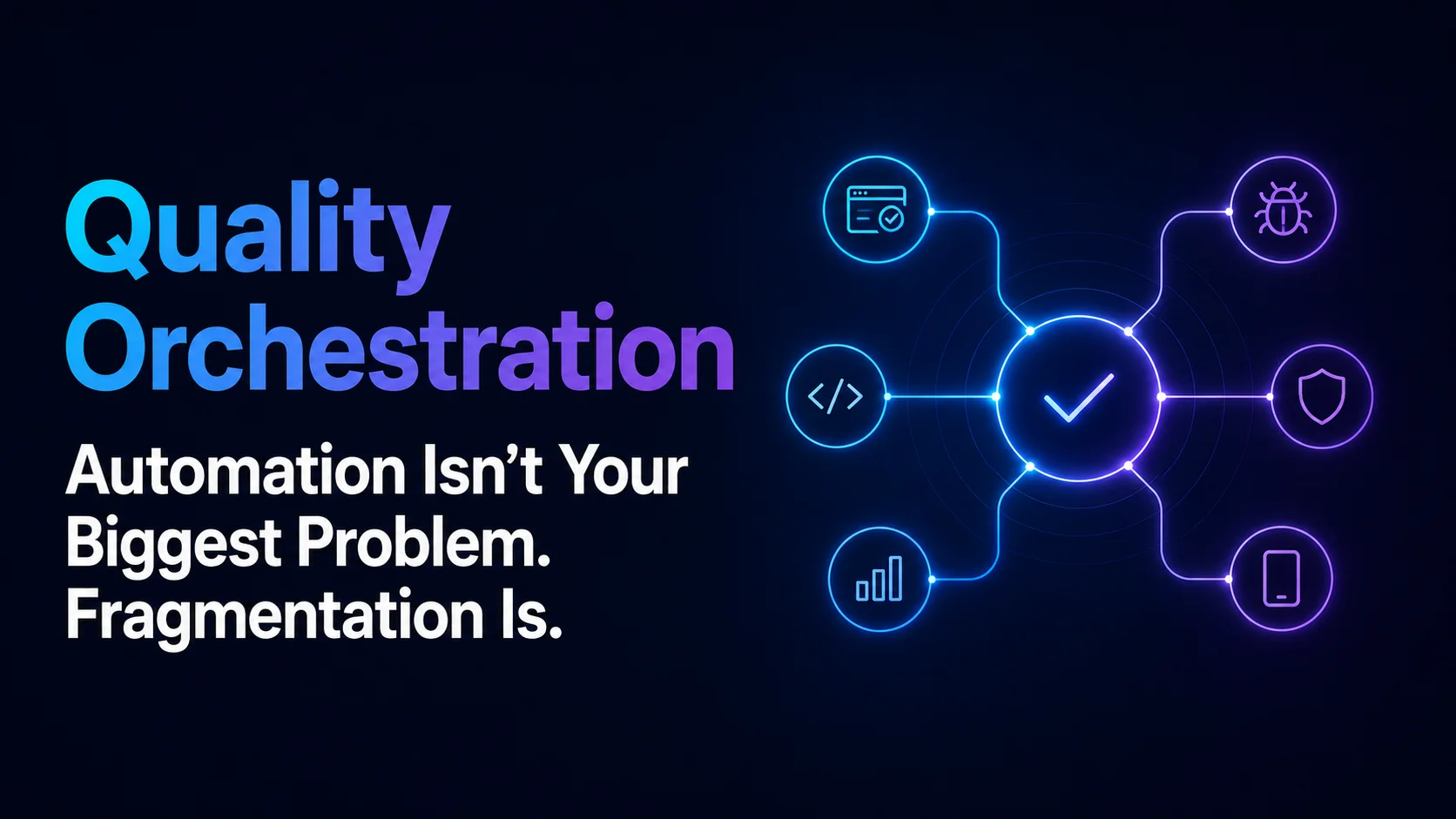
Automation Isn't Your Biggest Problem. Fragmentation Is.
Over the last decade, organizations have invested millions in software testing tools.
They've purchased:
- Test automation platforms
- API testing frameworks
- Performance testing tools
- Accessibility scanners
- Security testing solutions
- CI/CD platforms
- Test management systems
- Defect tracking applications
Yet despite all of these investments, engineering leaders still struggle to answer one deceptively simple question:
"Are we truly ready to release?"
The problem isn't a lack of automation.
The problem is that every quality activity operates independently.
Testing happens in one platform.
Requirements live somewhere else.
Defects are tracked in another system.
CI/CD pipelines generate separate reports.
Production monitoring exists in its own dashboard.
Engineering teams aren't suffering from a lack of testing.
They're suffering from a lack of orchestration.
What Is Quality Orchestration?
Quality Orchestration is the intelligent coordination of every quality activity throughout the Software Development Life Cycle (SDLC).
Instead of treating software testing as disconnected tasks, orchestration connects every validation activity into a single, continuous quality workflow.
Think of an orchestra.
A violin section can perform beautifully.
So can the percussion.
The brass section may execute flawlessly.
But without a conductor, the performance quickly loses harmony.
Modern software development is no different.
Developers.
Quality Engineers.
DevOps.
Security.
Product Managers.
Operations.
Each performs an essential role.
Quality Orchestration ensures they perform together.
Software Testing Is No Longer One Discipline
Modern applications require multiple layers of validation.
No single testing practice provides enough confidence on its own.
A mature Quality Engineering strategy orchestrates every testing discipline into one coordinated quality pipeline.
Modern Quality Engineering Ecosystem
|
Quality Capability
|
Business Purpose
|
|
UI Testing
|
Validate customer workflows and user experience
|
|
API Testing
|
Verify backend services and integrations
|
|
Mobile App Testing
|
Ensure consistent experiences across iOS and Android
|
|
Accessibility Testing
|
Meet WCAG and ADA compliance requirements
|
|
Performance Testing
|
Validate scalability under load
|
|
Security Testing
|
Detect vulnerabilities before production
|
|
Regression Testing Services
|
Protect existing business functionality
|
|
Test Case Management
|
Organize reusable quality assets
|
|
Requirement Traceability
|
Connect business requirements to validation evidence
|
Each capability produces valuable information.
Quality Orchestration connects them into one decision-making process.
The Difference Between Automation and Orchestration
Many organizations believe they're mature because they execute thousands of automated tests every day.
Automation is important.
Orchestration is transformational.
Automation answers:
- Did this test pass?
- Did the API respond correctly?
- Did the browser workflow succeed?
Quality Orchestration answers:
- Which business capabilities remain at risk?
- Which customer journeys were never validated?
- Which automated tests should execute based on today's code changes?
- Which release carries the highest operational risk?
- What evidence supports today's deployment decision?
One focuses on execution.
The other focuses on intelligence.
Orchestrating the Entire Software Development Lifecycle
Quality shouldn't begin when testing starts.
It should begin when software is conceived.
The most mature engineering organizations orchestrate quality from the very first requirement through production monitoring.
Phase 1 — Business Planning
Quality begins with defining measurable business expectations.
Questions include:
- What business process is changing?
- What customer experience must be protected?
- What regulatory requirements apply?
Phase 2 — Requirement Validation
Every requirement should be:
- Testable
- Traceable
- Measurable
Requirement Traceability ensures every business objective can later be validated through software testing.
Phase 3 — Development
Developers continuously receive automated feedback through:
- Unit testing
- Static code analysis
- Security scanning
- API contract validation
Quality becomes part of development rather than something inspected afterward.
Phase 4 — Continuous Testing
Once software enters the CI/CD pipeline, orchestration coordinates:
- API Testing
- UI Testing
- Mobile App Testing
- Accessibility Testing
- Performance Testing
- Automated Regression Testing
Rather than executing every available test, intelligent orchestration determines which validation activities provide the highest confidence for each deployment.
Phase 5 — Release Readiness
Before deployment, Quality Orchestration evaluates:
- Test Coverage Analysis
- Requirement Traceability
- Defect severity
- Security findings
- Performance results
- Quality KPIs
- Release Risk Analysis
Instead of approving releases based on opinion, organizations rely on measurable evidence.
Phase 6 — Continuous Learning
The lifecycle doesn't end after deployment.
Production telemetry continuously feeds information back into engineering.
Escaped defects.
Customer issues.
Performance trends.
Usage analytics.
Quality Health Monitoring.
Every release improves the next one.
AI Is Transforming Quality Orchestration
Artificial Intelligence is accelerating software development faster than any technology before it.
Developers now generate:
- Source code
- Unit tests
- Documentation
- API mocks
- Test data
Soon AI will also orchestrate quality activities.
Imagine a platform that automatically determines:
- Which requirements changed.
- Which APIs are impacted.
- Which regression tests should execute.
- Where automation coverage is insufficient.
- Which production risks are increasing.
- Which teams require engineering support.
Instead of manually coordinating dozens of testing activities, AI will continuously optimize the entire quality process.
This is the next evolution of Quality Orchestration.
Why Engineering Leaders Should Care
Engineering leaders aren't measured by how many automated tests execute overnight.
They're measured by:
- Release predictability
- Production stability
- Customer satisfaction
- Engineering velocity
- Operational risk
Quality Orchestration directly improves each of these outcomes by ensuring every quality signal contributes to a single engineering decision.
Instead of isolated dashboards, leaders gain one comprehensive view of software quality.
The Future Isn't More Testing
Every year, organizations add more testing tools.
More dashboards.
More reports.
More automation.
But complexity continues to increase.
The future of software quality won't belong to organizations with the largest regression suites.
It will belong to organizations capable of orchestrating quality across every application, every team, every deployment, and every customer experience.
The winners won't execute more tests.
They'll execute the right tests, at the right time, using the right intelligence.
Key Takeaways
- Quality Orchestration connects every testing discipline into one continuous quality strategy.
- UI Testing, API Testing, Mobile App Testing, Accessibility Testing, Performance Testing, and Security Testing should work together and not independently.
- Enterprise Test Management, Requirement Traceability, and Test Coverage Analysis provide the foundation for coordinated software quality.
- AI will increasingly orchestrate testing activities, optimize regression execution, and improve Release Readiness.
- Organizations that orchestrate quality across the SDLC deliver software faster, reduce operational risk, and improve engineering productivity.
Final Thought
For years, software organizations have invested in building better testing tools.
The next competitive advantage won't come from another automation framework.
It will come from connecting every quality signal into one intelligent system that continuously guides engineering decisions.
That's the promise of Quality Orchestration.
Not more testing.
Better software through intelligent coordination.