
Bring the product context
Use requirements, existing test plans, expected behavior, and authorized application access to guide exploration. Engineers clarify ambiguous rules instead of letting generated assertions define the product.
Turn product context into reviewed regression coverage.
QA Bolt combines autonomous workflow exploration, requirements-driven AI case drafting, executable test generation, and engineer review in a managed engagement.
Available through managed engagements. Real QA expertise. No sales pitch.
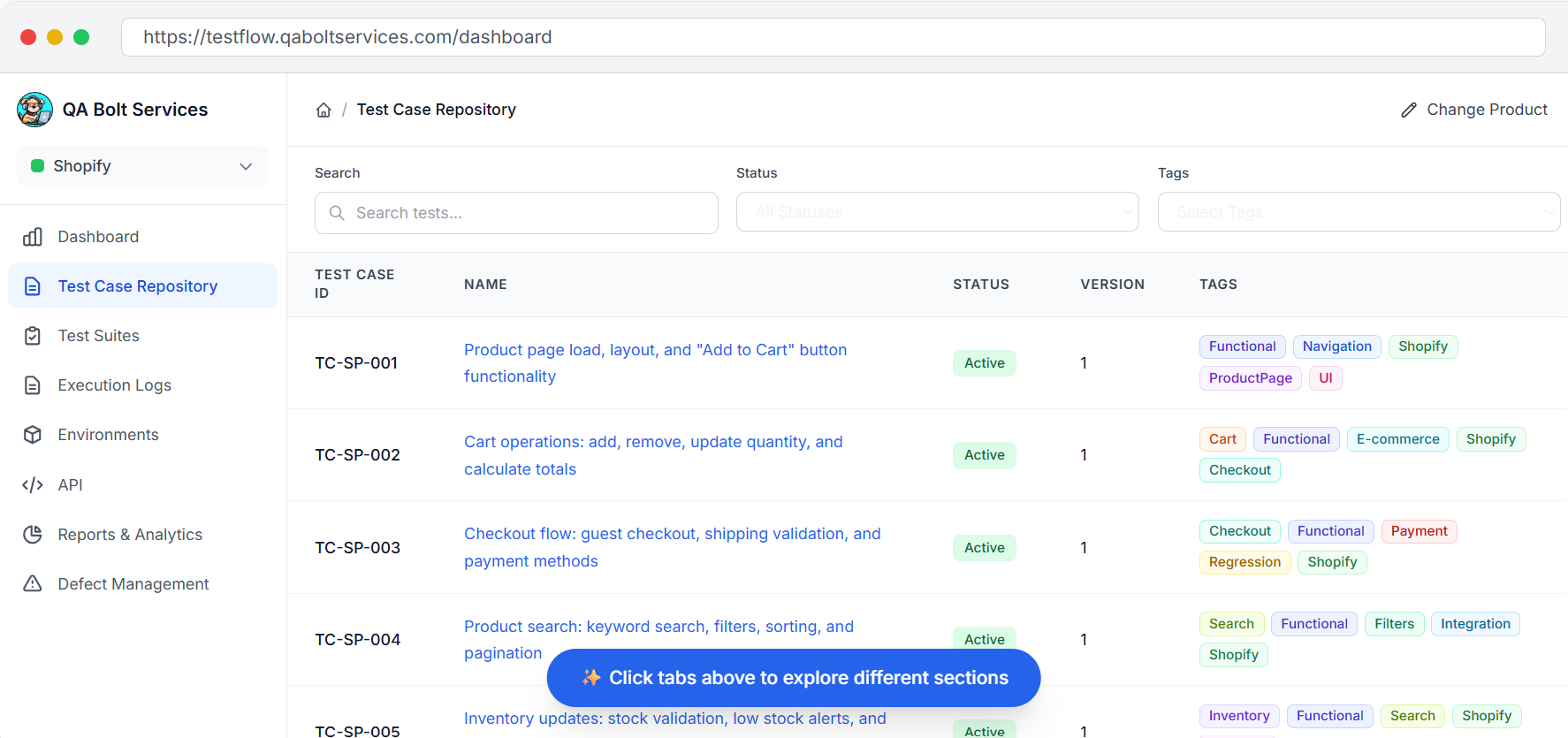
AI test case generation can connect product documentation and observed application behavior to a testing backlog. QA Bolt uses autonomous application exploration and requirements-driven drafting to identify candidate workflows, then brings engineers into review before adoption. Executable Playwright or Appium generation helps move suitable cases toward regression. Generated candidates are not automatically proof of complete coverage or correct expected behavior.
Use requirements, existing test plans, expected behavior, and authorized application access to guide exploration. Engineers clarify ambiguous rules instead of letting generated assertions define the product.
An agent explores the agreed application scope and maps workflows. AI drafts candidate cases from this behavior and the supplied context, highlighting journeys for review rather than claiming that every path was discovered.
Engineers review preconditions, steps, expected outcomes, and business relevance. Suitable cases can become executable Playwright or Appium tests within the supported environments.
Suggested coverage evolves with product changes. Review keeps new and revised cases aligned with acceptance criteria, regression priorities, and maintenance needs.
QA Bolt connects generated candidates to reviewed expectations, executable automation, and managed operation. Product owners remain involved in clarifying behavior and prioritizing risk.
Preconditions, steps, and expected outcomes need explicit review. A discovered behavior is not necessarily the intended product behavior.
Reviewed cases can become Playwright or Appium checks, with agreed data and supported environments. Mobile execution excludes real devices.
Suggested coverage changes with the product. Review and maintenance keep the suite tied to requirements, known gaps, and release readiness.
The current program is $7,000 per month for four months: $28,000 for the published baseline. It includes platform access and customer-owned assets. Discovery establishes the specific product scope and any additional requirements.
The published commitment is 200 automated regression tests in the first 30 days, not 200 generated drafts in minutes. No autonomous-discovery completeness, generation-speed multiplier, separate self-service price, or AI-output evaluation is promised.
Yes. QA Bolt can draft cases using requirements and existing test plans, alongside autonomous exploration of the agreed application scope. Engineers review the candidates before adoption.
No. Candidates need review for expected behavior, feasibility, data, and value. QA Bolt supports executable Playwright/Appium generation for appropriate workflows and agreed execution environments.
No generation-speed or universal discovery benchmark is published here. The existing program commitment is 200 automated regression tests in the first 30 days of the scoped 120-day transformation, which is different from generating draft cases.
Bring approved requirements, existing test plans, critical journeys, and application-access constraints. Agree roles, environments, test data, and review ownership. Do not send credentials or sensitive production data through an initial inquiry.
No. Exploration and drafting produce candidate coverage, not proof that every path was found. Engineers review business rules and acceptance criteria, and coverage reporting should distinguish approved checks from remaining gaps.
Discuss the product context, existing tests, and review process needed to turn generated candidates into dependable regression.
Talk to a QA Engineer